

On Sunday I went to a Muay Thai match. I have never seen a combat sport live in my life. I am very glad that this was my first experience of this kind: in this post I will tell you why I think so.
Before telling my own story, let me take a little detour to introduce what this sport is!
Muay Thai
Thai boxing is not just a martial art. In Thailand, it is culture, identity and everyday life. If you like, it is like a fusion of a dance and a battle. The movements are rhythmic, almost dance-like, but behind each punch there is decades of tradition, discipline and brute force.
The art of the eight limbs: that’s what it’s called. Because it’s not just your hands that are working here:
- hand,
- foot,
- knee,
- elbow.
These four paired body parts make up the “eight limbs.” The elbow, for example, is smaller than a fist, but much sharper – when you see or feel it in person, you immediately understand why it is a feared weapon.
And there is a ceremonial, respectful side to it all.
Before the fight begins, the fighters do the Wai Kru, which is a kind of dance, a tribute to their master, their family and tradition. You can see from them that this is not just a sport for them: it is religion.
What does Muay Thai give a “mere mortal”?
Damn good stamina. Strength. Discipline. And a strange, confident silence inside.
A lot of Westerners come to Thailand to train: some to lose weight, some because they want to finally feel in control of their bodies. Some for self-confidence. And some who are just curious about the atmosphere of the whole thing.
The best thing about it is that it is human-friendly
The coaches here are not stars, not celebrities. They smile, joke, and help everyone, even if you are falling apart on the floor after a round. The kindness of Thai culture comes through even in this “hard” sport.
When the music starts to pulsate, the ring is no longer just a ring…
There was something very strange about that evening: before anyone moved in the ring, the air was already filled with a rhythm that slowly seeped under my skin. At first I couldn’t even tell where it was coming from, but I noticed that some strange, foreign, yet familiar pulsating melody was filling the room.
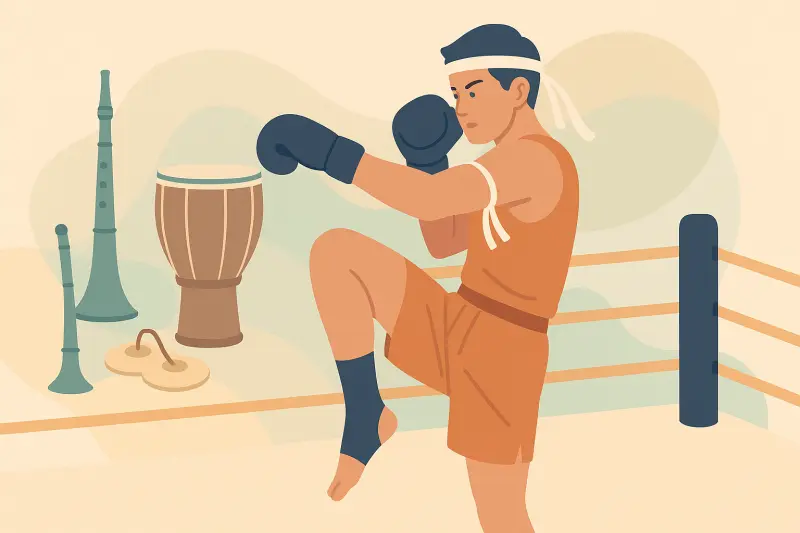
The sarama music is not just background music. It is the pulse of Muay Thai.
First the pi plays – a kind of Thai oboe. It has a slightly plaintive, slightly tearful sound, as if an old storyteller were sighing into it over the ring. The melody is always alive, always different, as if the musician were trying to decipher what was going on in the minds of the two fighters right there.
Then come the klong khaek drums. Two long, cylindrical drums that are beaten with the hands. The rhythm is at first subdued, as if it were just breathing. Then – as the fighters approach each other – it picks up speed. The drum doesn’t just accompany: it directs. It’s as if behind every punch and kick is the beating of the drummer’s heart.
And all this is accompanied in the background by the ching, the small cymbals. The same monotonous, pure rhythm that runs the whole time like some kind of spiritual metronome. If you closed your eyes, you would know exactly where the fight is going.
The three instruments together are like listening to the ritual music of an ancient tribe – only under lights, in a modern hall, with tourists and locals.
And the strangest thing is that as soon as the fight ends and the music stops, you feel a sense of loss.
As if the silence is too great.
As if the ring has lost some of its magic.
Muay Thai without music is like just two people fighting. But with music, Muay Thai is a ceremony.
How did I see Muay Thai?
I arrived first at the hall, where I was led straight to the chair reserved for me. Since the room was completely empty, I could easily look around without disturbing anyone. I looked at the ring and the fighting mat, the equipment and the judges’ chairs up close.
The match started half an hour later than the announced time, so I sat there for almost an hour waiting for it to start. Time passed slowly, but I didn’t mind. The place had a special atmosphere that I enjoyed feeling around me.
The match did indeed start with a certain dance called Wai Kru. It was performed by a warrior girl. I felt the tradition in every movement. I really like how in the bowing here I can see that it is not a routine movement, but real respect is reflected in it. The warrior girl’s movements were sometimes graceful, sometimes the movements of a real warrior. I was impressed by his performance…
The fighters appeared in the backlit door, accompanied by the booming sounds of their own music, in knee-high smoke. Some of the entrances were very dignified.
The fights were based on European rules and Asian rituals. The men’s fights were 5 rounds, the women’s fights 4. The judges strictly supervised the matches. There were judges on all four sides of the ring, who at the end of the fight gave their votes to their partner in the ring, who immediately announced the result.
For me, it was a bit strange that after the result was announced, the losing fighter immediately left the fighting area.
The experience came between the entrance and the fighters’ departure. What was primarily for me was not the fight, but the series of ceremonies.
I can’t write much about the fights. Maybe just that there were some tough moments that were painful to watch. After a bad move, the “offending” opponent turned anxiously towards his fellow fighter. Many times I felt that this fight was not about aggression, but about respect. Respect for the other fighter, whom I only want to defeat, not destroy…
Many hugged each other at the end of each round and smiled at each other. A few only greeted each other at the end of the match, but I saw that this was not left out in any case.
There was no KO.
If not about the fight, I can tell you more about the traditions I saw.
First, the fighters walked slowly, spiritually, around the ring. Holding the top rope with their right hands, they walked from corner to corner. They stopped at each corner to pay respect to those who made this moment important in their lives. To the master, to the family, to the religion, to the spirit of the ring and to the history of the sport.
The four corners of the ring symbolize the four directions of the world. During the full circle, the fighter thanks the past, pays respect to the present, and asks permission to fight in the future.
After the Wai Kru is completed, the fighters take their places in two opposite corners of the ring. An important accessory for the fight is a circular metal tub, the size of two chairs, with a side wall height of about 5 cm. A lot of water is poured on the fighter before and during the breaks, this tub will catch that water. At the end of each round, the assistants immediately put it there, before the start of the round, they pour the water out, put the tub aside and wipe the ring clean.
The master washes his student’s hair or splashes water on his face and chest. Most of them have washed their hair. He ceremoniously gives the fighter a sip of water to drink, who then stands in the middle of the ring. He greets his opponent, and then the fight begins.
During the break after the rounds, the fighter sits down and immediately begins to bathe him. Massage and stretch him. In the meantime, of course, the coaches and assistant coaches are constantly talking to him.
The referee wipes the fighter’s gloves and upper body before each new round. I think this is also part of the tradition.
As I said, during the fight, the fighters pay attention to each other, they can smile at each other, they can apologize, and it is obvious that they can also worry about each other.
During the fight, the music, which is unlike anything else, is constantly pulsating, the pi instrument really seemed to hypnotize me. I felt an incredible atmosphere.
I only noticed my fondest experience, my memory, at the end of the second fight. I think, as a kind of closing element, the master gives his student a drink at the end of the fight, just as he did before the fight. Then the master gives the other fighter the same drink. This kind of respect still gives me a warm shiver…
I got a lot more than I expected
I went to see a fighter’s night, thinking I would have a good time. I got much more than this simple experience! The respect appeared to me in such a concentrated form during the evening that after the match I just sat in silence on the street for a while. And I thought about how nice it would be if this respect permeated all of our everyday lives…
I want to be a fighter like that. Not because of the fight!
Buy me a coffee?

If you enjoyed this story, you can buy me a coffee. You don’t have to – but it means a lot and I always turn it into a new adventure.
Buy a coffee for Steve
 Linktree
 Short introduction