

Meditation is a fairly common topic for me.
I mentioned the word “meditation” in 18 of my posts, and the term “meditation” in 40 of my writings.
However, what is much more important to me is that this activity not only appears frequently in my writings, but has now become a part of my everyday life.
The reason I finally wrote this post is because this topic comes up often in my everyday conversations.
What does meditation mean?
When writing a piece like this, I can’t help but approach this important word – meditation – by taking a look at what the term itself means.
I promise I won’t be getting too scientific in this piece. I simply ask that you aim to observe the key words as you read through this short section.
How do others describe what it means to meditate?
- Classic, short definition: Meditation is a set of mental practices that aim to regulate attention, develop awareness, and observe internal processes.
- More academic formulation: Meditation is a structured mental practice that helps to observe thoughts, emotions, and bodily sensations, usually in a non-judgmental way, by focusing attention and maintaining awareness.
- Psychological approach: Meditation is a collective term for techniques aimed at consciously observing and regulating cognitive and emotional processes, which are often used to improve mental well-being and attentional functioning.
- More scientific description: Meditation is a collective name for mental training methods that influence cognitive, emotional, and physiological processes by directing attention and developing conscious presence.
What does meditation mean to me?
The above paragraph is – not by chance – quite a “scientific” approach to – in my opinion – be alarming.
I will have to tell you how and when I encountered meditation, but I will say in advance that I did not approach the topic from this side.
Fortunately.
If I start from here, I may never become a practicing meditator.
My – chosen – definition is much simpler than it can be alarming.
Most of us take a shower or bath every day. Simply to cleanse our bodies of the dirt that has accumulated during the day. I meditate to shower my mind a little from the mental dirt that has been pouring on it all day.
That’s it and nothing more.
Meditation is not something so complicated and special that it requires a lot of attention to practice. In addition, a very important experience of mine is that the “state” (whatever it means, e.g. calm, balanced, attentive, conscious, etc.) is the consequence of this activity and not its goal.
Using the shower example: I shower my consciousness to wash off a little of the informational dirt that has accumulated on it. As a result, my consciousness will be fresher. Exactly the same way that the body relaxes after a pleasant shower.
For me, there is another important element of the presence of meditation in my life.
Meditation is not a religious practice. It is a generally usable tool. Which, by the way, appears in many religions, let’s think of Buddhism, but we can also think of the prayer customs of the Muslim or Christian religions.
It was a pain all the way
For three decades I was “unsuccessful” with meditation, which appeared in my life when I was 13-14 years old.
It came knocking on my door from VHS tapes.
It often appeared in a layer of action movies that were coming to Hungary at that time.
Blood Sport, American Ninja, Karate Kid, The Way of the Dragon…
The image appearing in the movies was an unattainable dream: sitting in a lotus position with your eyes closed and catching a flying fly with chopsticks… And who wouldn’t want to achieve unattainable dreams?
So meditation came to me from a “dream image”, I had no other goal with it then than to become like the actors in the movies.
Then came more serious knowledge. Trainings, studies, readings. Mind control, Mindfulness, meditation courses, lectures. And I found myself on the “scientific” side, which did not take me further on my path.
I started regularly, and then after unsuccessful attempts, I stopped meditating regularly.
I never achieved perfect silence. The state when there are no thoughts in my head. A higher consciousness never appeared. Enlightenment did not touch me. I did not visit other universes.
In retrospect, I can see that my goals were poorly formulated, if they were formulated at all.
Last year I set out to start over differently.
I simply started over. Much more simply.
The suffering ceased
A few months after I had not stopped – it was because of the novelty – my mother asked me once: “Have you managed to learn to meditate yet?”
Then I thought for a while and said no. I had not managed to learn. Because I didn’t want to learn it now. I didn’t want to set a goal. I simply started doing it. Not scientifically. Not by choosing any method.
I just sat down on a chair, closed my eyes and watched. I focused on regularity alone. Of course, I didn’t always succeed, but this time it didn’t deter me from practicing.
I wasn’t looking for a way to clear my thoughts. I didn’t want the perfect place, nor did I want perfect silence. It didn’t hurt anymore if my thoughts wandered. It wasn’t a problem if I had to scratch my nose in the process.
I didn’t care that I couldn’t sit in the lotus position. The chair was perfectly fine for me. It didn’t matter what time of day I took the time to do it.
By starting to “do” it, I realized a lot.
For example, there is no place in my environment or time of day when the world around me is completely silent. There is always a car driving by the window. There is always a dog barking. If I went out into the woods, I would hear the birds. I can’t ask the waves on the beach to stop for fifteen minutes.
There is no perfect place. No ceremony. No incense. No white clothes. No meditation music. I don’t need anything to practice.
And, if nothing is needed, nothing is in the way.
I just do it. I do it. Simply.
How do I meditate?
All that’s left is to tell you how meditation works for me.
Along with describing my experiences, I also have to say that it certainly doesn’t hurt to read and prepare for this activity if you want to become a practitioner. I’m not sure that my method will be good for you.
It’s worth looking for sources about meditation, if only because there are certain things that are worth getting to know and then deciding how useful they are for you.
For example, the two cornerstones of meditation are definitely important: physical and mental comfort. Books are written about this or courses are created.
I’ll start with physical comfort.
This part is not really important to me. I can meditate just as well sitting on a staircase as on two comfortable pillows in bed. It doesn’t matter to me whether I sit in a half-cross or with my legs outstretched on the floor. In the case of a chair, it doesn’t matter whether it has a usable back or not.
I don’t have a specific, chosen hand position. I don’t know or use mudras. I sit down, hold my body, hands, palms, etc. as feels right at the moment.
Mental comfort.
This roughly means that we meditate with a mind without expectations, with eyes closed, and a relaxed body.
I don’t prepare myself in any way to meditate. I sit down (or more rarely, I lie down), close my eyes, and start. I don’t stretch before, I don’t warm my closed eyes with my palms, I don’t do breathing exercises.
When I start meditating, I don’t go through my body parts one by one (from head to toe, or vice versa) and relax them. I don’t need to.
I have no expectations of myself, so I start from one moment to the next and I’m already in it.
I have to mention again that this is my method. If your meditation cushion, meditation corner, music, perfume, mudra, preparation, etc. are important to you, then that’s fine. If meditation is more of a ritual for you, please don’t change your method.
What do I pay attention to?
I immediately start paying attention to my breathing. I don’t say to myself “in”, “out”, I don’t use the “Buddha” vipasana mantra. I simply “just” notice how I breathe. It was a serious experience for me when I noticed that I was “doing” breathing and noticing this “doing”.
Simply put, it is important for me not to want to inhale the air and at the same time be aware that it is “going in now”, just as I don’t start to “blow out” the air and at the same time feel it leaving.
As my body does, so be it and I pay attention to that.
I also pay attention to my body, but not in parts, but as a whole. I don’t concentrate on a single part of my body, as I don’t want to feel myself. I almost always feel my body as a whole. At the same time, where the chair or the floor presses on me. Where is the tension in my legs, if I sit with my fingers crossed, how do they tighten each other? If my back hurts, that is also there in a “picture”.
I chose these two “anchor points” for myself, but the choice was not made consciously. I simply started using them.
How do I pay attention?
This is the hard part to say. I try not to pay attention. To nothing else but my breathing. But whatever my attention is focused on during meditation, I try to put concepts, names aside from my mind. Unfortunately, I can’t say this in any other way.
Maybe an example will help: if I hear people talking near me, I don’t want to give this activity a name. I don’t think that they’re talking. I don’t think in what language. I would say that I let my mind perceive the sound, but that wouldn’t be true. I don’t let it, my mind does that on its own.
That’s why there’s no quiet place anywhere. There are noises everywhere and my mind wants to react to them. To say that this is a “cat,” this is a “car,” this is “Chinese speech.” Well, I avoid saying that.
For me, the best way is to return to the breath without effort. Not in a hurry, not in a hurry, but before the mind gives a name to the sound, I pay attention to my breath again. It doesn’t matter if it’s “out” or “in”, whether the breath is just starting or the rhythm is halfway through.
If I do give a name to the sound, to the thought – of course, this happens in most cases – then there is no problem.
Thoughts come and go in my head constantly. They often take me with them. But after a lot of practice, I now notice more quickly that I have sat on the back of one of the butterfly-winged thoughts, and at that moment I return to the breath.
Without any judgment or disappointment. From one aspect, my meditation is nothing more than me wandering for moments – shorter or longer moments – and then returning to the breath. One hundred times ten minutes, if that happens. There is no spasm, no disappointment in me. I start again. Then again and again. Then again.
In many meditation descriptions, the cloud is used to personify a thought. I look at thoughts in this way too. The wind blows the cloud of thought in front of me. I look at it, I think about it, if it can carry it away. Then the wind carries the cloud further. And the other one comes.
An important understanding for me was that I do not let the cloud go, as I have read in many places. The wind brings it, the wind takes it away. I can control my attention, not the cloud.
I found two techniques that helped me. By the way, I took these by chance in the Buddhist forest temple. They were not taught in the temple, they simply came to me there.
One of my techniques is to immerse myself in any thought, to close it with a thought that is characteristic of its nature. I have two closing thoughts. One: “This is all beautiful/sad/true/untrue etc. but this is the past and now does not belong here.” The other: “This is all beautiful/sad/true/untrue etc. but this is the future and now does not belong here.”
That’s it.
Of course, I don’t recite this to myself in such a cacophonous way. I let the thought work briefly and firmly. “This is the past. There’s no time now.” “This is the future. It doesn’t have to be solved now.”
The third time plane is the present. If this appears, then I’m in place, because I’m meditating and I don’t want to think about anything. Experiencing the present is not only the essence of my meditation, but also the reality of its given moment. In other words, only meditation exists in the present, so I don’t need a closing or evasive sentence for this.
My other technique applies exactly to this present. More precisely, to the moment.
I found the idea that I “have to” “do” only one moment “perfectly”. The many quotation marks are not a coincidence. I “have to” do nothing, nothing is “perfect” and I “do” nothing.
Everything just comes by itself. However, if I think that my thoughts are wandering, then with this expression – only this moment exists and it is perfect – things fall into place. The given moment is good as it is. I can even call it perfect, with its fallibility and flaws. This gives weight to that moment.
On the other hand, it is important that I can definitely experience a single moment in its perfection. And the moment is already gone. I have the opportunity to experience the next one perfectly.
This way, meditation really becomes easy for me. I don’t work on being perfect in it, just on the fact that the given moment can be. It is very easy for me to concentrate on a single moment.
If I can apply this method to life, I will be able to do anything. LOL. After all, if I run, for example, I only have to run for one moment, it doesn’t cost anything, I can handle it. Then another moment and another. I could run to the end of the world.
In summary: I focus my attention on the present, more precisely on a single moment.
This has worked for me.
I can also say that my method is a mixture of the “Samatha” (I focus on my breathing) and the “Vipassana” (I pay attention to my thoughts) methods.
This has worked for me – now.
I made a contract
Many meditation teachers believe that there is only one thing that is important: daily practice.
So this year I made a contract with myself to practice every day. I have heard from several Buddhist monks that even after many, many years of practice, they still call themselves “practitioners,” not meditation masters.
I have also “officially” become a practitioner. Here is my contract:
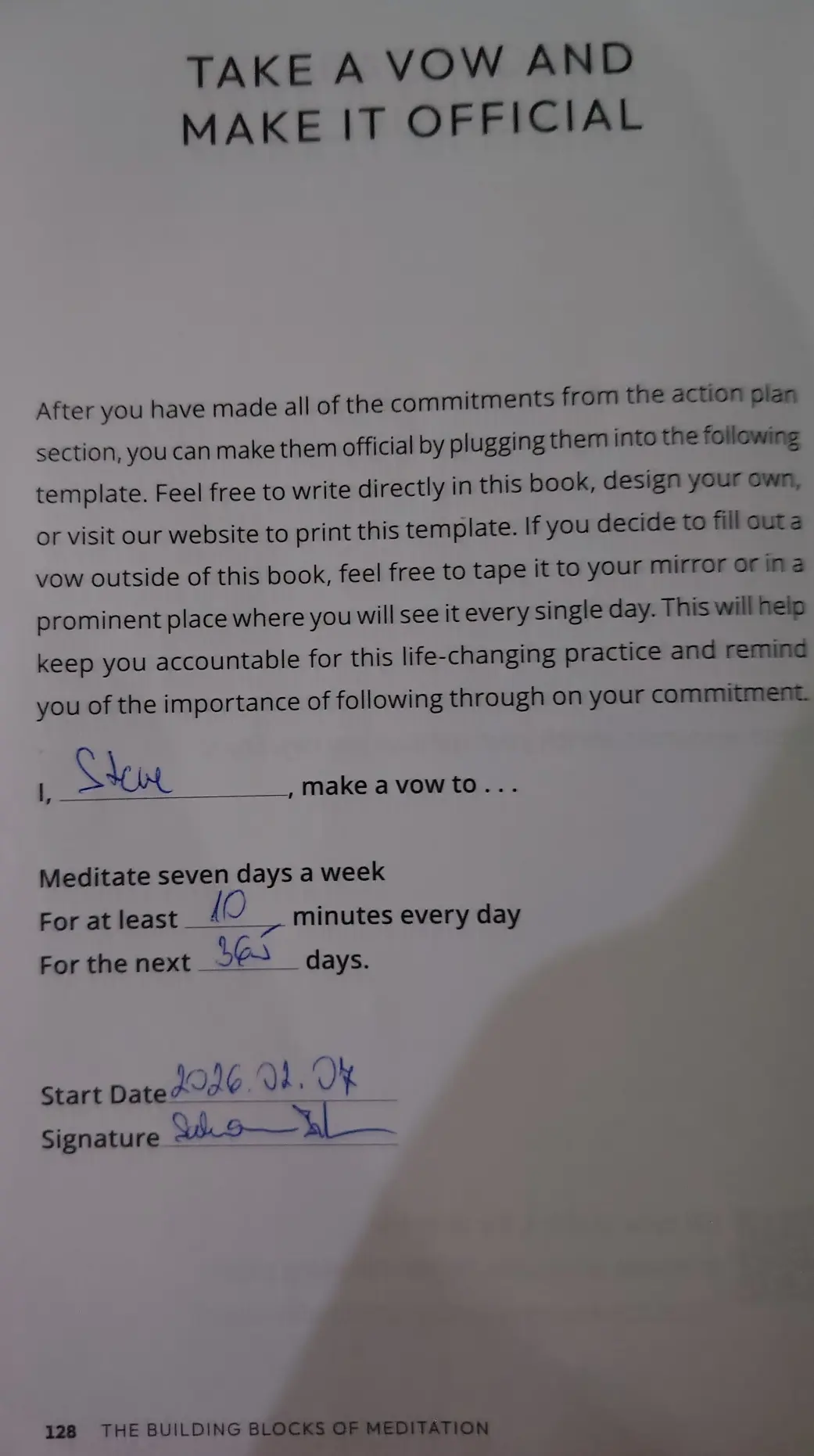
I also created a meditation practice tracking chart, which I started at the beginning of January. It shows that I meditated for 41.5 hours this year. At the time of writing this sentence, 163,528 minutes have passed this year. Of these, I spent 2,493 minutes meditating. This is 1.52% of my total time.
This is what I have been able to do for myself so far this year. I do not regret a single minute that I have spent on this activity.
I really like that meditation has become part of my journey. A small path that I wander onto every day in my continuous progress.
Finally, I’ll show you a colorful page, because it was also part of my journey:
I met an artistic soul during my journey, which I have mentioned a few times in my writings. During conversations with him, the idea of a “fine art” series emerged. “Fine art”, which is a work of art that exists for itself, as an expression and idea, and not for the purpose of use.
My “fine art” series is titled “Stillness in Motion,” which you can view by clicking on the title.
Postscript:
I’m interested in this topic, which is why I wrote about it.
And I read it often.
If you’re curious about what’s left when you strip away the hype and misunderstandings about meditation, this is worth reading:
Meditation and mindfulness: when words have worn down to the bone
Integrative Leader | Mindfulness Instructor (MBSR)
September 30, 2025
Or beyond the hype, Buddha statues and fake quotes
Human life is full of misunderstandings, and meditation is no exception. In fact, there are perhaps few words that have been so worn out by exaggerated enthusiasm in recent decades as “meditation”, and with it “mindfulness”. Too much hype, too many promises, and then too many superficial applications have almost completely emptied the words.
In today’s world, a thousand voices are buzzing around us in this field: books, teachers, advertisements, quotes. Everyone thinks they know the answer. And yet: the louder the chorus, the greater the confusion. It is no wonder that people sometimes lose track.
Asian traditions are mixed with Western translations, mistranslations, clichés and pop cultural kitsch. The Buddha statue sold in the DIY store has become as much a “voice” in this chorus as the attractive, but mostly fake, Buddha quotes in memes. It’s hard to navigate.
I don’t claim to be in possession of the truth either. With fifteen years of daily practice, two and a half professional degrees, and many rigorous retreats behind me, I prefer to think that I have only ventured closer to something. What I am sharing now is not dogma, but rather a silent testimony of what I have experienced in practice.
Libraries and Reality
You can read books about meditation and mindfulness, several libraries full. I have quite a few of them too: some are thought-provoking, educational, uplifting, wise, or practical. But they are all a bit like works about dancing or swimming. Just as you don’t learn to dance or swim from a book, meditation only reveals itself in practice: sitting, breathing, and paying attention.
Some mistakes that should be clarified:
- Meditation is not the turning off of thoughts. Thought is to the mind what hearing is to the ear: its natural function.
- Meditation is not a fight. We are not getting rid of anything, we are not defeating anyone, especially not our “ego.” Rather, we are making peace with everything that is within us.
- Meditation is not a static state to be achieved, to which we cling and never let go. It does not work in the way that “now I meditate, I am in Zen, then I step out of it and madness takes over me”. The purpose of the practice is not to build an artificial refuge, but a process that, if we are persistent, slowly permeates our everyday lives and helps us function in countless ways.
- Meditation doesn’t require any props. No candles, no incense, and certainly no music. Of course, you can light a candle, burn incense, listen to meditative music, they’re atmospheric, and sometimes I do that too. It can be a ritual, it can be relaxation, but it’s not meditation. Silence and attention lie not in smells and sounds, but within us.
- “Ideal places” are not necessary either. As a practicing Buddhist, I have meditated in the most sacred places—and to my surprise, once the initial awe wore off, I experienced exactly the same things I did at home. We carry our perspectives, thoughts, and habits with us everywhere we go.
- Hand gestures and mantras can also be tools, but they are not essential elements.
The polar opposites of the above can all be found separately in the teachings of some traditional or modern school. But it is not worth getting into a debate about them. The world of meditation has always been diverse, and each tradition has tried in its own way to bring people closer to the essence.
So let there be freedom: let a hundred flowers bloom. Let everyone practice in the form and in the way that is closest to their heart. The point is not the form, but that the practice be alive and slowly permeate everyday life.
What is actually happening
Meditation is a process: a movement that is both relaxed and focused. Attention wanders, again and again. And we bring it back, again and again. This return is the practice itself. It is not a mistake, it is not a failure, but the path itself.
It sounds almost confusingly simple, doesn’t it? And yet: everything lies in this simple movement. This small technique is what opens up the long list of positive changes that the practice of meditation can bring to our lives, now validated by science.
The essence of mindfulness, as Dr. Jon Kabat-Zinn puts it, is intentional, present, and non-judgmental attention. It is not about banishing or suppressing thoughts, but about observing them peacefully and quietly.
And here it is worth making a distinction: mindfulness, or conscious presence, is not the same as meditation. Conscious presence can be with us even in the smallest moments of everyday life – when we walk, when we listen to someone, the wind caresses our face, or when we raise a glass of water to our lips. It does not require either formal or informal practice. Mindfulness does not begin on the pillow, and it does not end there: it can be present even when we are simply living.
When meditation is not the way to go
We also have to be honest: practicing meditation is not for everyone, and it is not the right tool for every situation. If someone is in acute crisis, carrying unresolved trauma, or struggling with a serious mental health challenge, then the first step is not meditation, but seeking professional help.
Meditation is not a substitute for therapy or medical treatment. Unfortunately, over the past fifteen years, I have encountered several situations where someone has tried to “solve” their deeper problems with it. It has never ended well. Mental health is not a game, it is not like IKEA furniture that you can assemble yourself with an Allen key. Serious injuries are not cured by home repairs, but by expertise.
And if at any time during your practice intense, unbearable feelings or thoughts arise, allow yourself to stop. Part of being mindful is recognizing when a different path, a different help, is needed.
Summary
Meditation is not magic, nor is it a privilege. It does not require any special talent, only willingness, perseverance and a little experimentation. A path that invites us to turn to ourselves with openness and friendliness, and through this to improve the quality of life of ourselves and our surroundings.
If you feel: “I am unable to meditate because too many thoughts come”: know that you are in the right place. This is not a sign of failure, but learning itself.
I wish you a good practice!
Buy me a coffee?

If you enjoyed this story, you can buy me a coffee. You don’t have to – but it means a lot and I always turn it into a new adventure.
Buy a coffee for Steve
 Linktree
 Short introduction