
In this post, I do not seek to think about the absolute truth of my statements.
“I May Be Wrong” Does the title of the post sound familiar? That is where I am starting from. I may be wrong, but this article is about the way I see the world now.
So its truth is absolute. For me.
It is not a recipe, not a teaching, not the announcement of the results of a competition. It was intended to be nothing more than an answer.
In recent months, I have heard very often that “I understand what you are saying, but I cannot live it.”
“I am not yet where you are.” “I am not at the level that you see the world.” All these are signs that suggest another wave, another dimension, another spirituality. I consider it important – and I am writing this entire article in the spirit of this: there are no levels, no places. There is no backwardness. You have states. And these are necessarily different.
I also often receive a rope from another wave, thrown by someone with the intention of saving me.
“Your writings are as if you want to see the good in everything.” “I don’t see what your purpose in life is, and you can’t live without a purpose.” “How do you explain this or that?”
I don’t need to be saved. There’s nothing to it. I’m where I need to be. I don’t want to see things in any way. I don’t look for purposes that others consider important. I don’t explain anything to anyone but myself. And I don’t always consider this important either.
For a long time now, I’ve felt that I have difficulty expressing how I see the world now. Yet, in almost every post I write about this through my experiences.
My goal is not to convince you or to make myself understandable at all costs. But I’m glad if this writing brings you closer to understanding my thinking.
Now, in connection with a special experience, I’m going to go deeper in a different way.
I hear differently
I’ve noticed something about myself in the past few weeks.
Something strange.
Of course I knew this would be a post.
About music, but not about it
I will never get tired of telling you how important music is in my life. I hope you don’t get tired of hearing it from me again from time to time.
I’ve written about this topic in my articles “My thoughts on singing” and “The role of music in my life”.
And although my self-discovery is close to music, this time it won’t be about that.
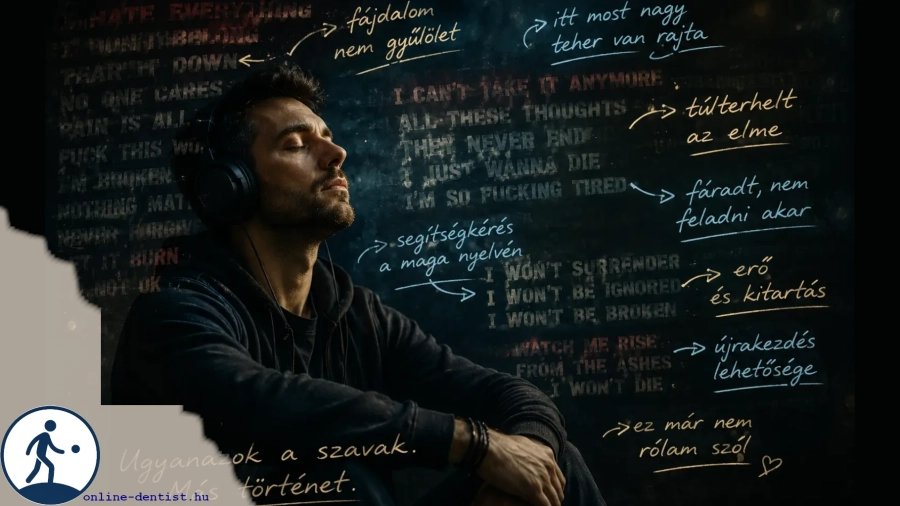
I paid attention to the lyrics.
To be precise, to how the lyrics of songs have been speaking to me these days.
Identification with poems
I randomly selected a few phrases to give the music a moment of spotlight before I put the lyrics on the stage of my thoughts.
What does music do to me?
It moves. It gives me strength. It makes me think. It motivates. It cheers me up. It saddens me. It sensitizes me. It slows me down. It speeds me up. It calms me down. It energizes me.
And in these flows, the lyrics of the songs play a very important role for me. In the rarest cases, I like those songs that, even if they are musically good, do not tell me anything about themselves in terms of their lyrics.
I have been paying attention to the lyrics of the songs I listen to my whole life.
I often feel that these lyrics are about me too.
I still feel that way now, it has not changed. Only the interpretation of the words has changed recently.
How does music work scientifically?
For me, the most important value in music is the energy it gives.
Many years ago, I first read that if you want to switch off or maybe need something to energize you, then start your favorite music – whatever it is – and you’ll have achieved your goal.
According to psychology, it’s no coincidence that we instinctively reach for our favorite music. Beloved songs can regulate mood, mobilize energy, evoke memories, and even activate the brain’s reward system.
Anger
Metal is my favorite music genre.
It has everything in it.
Pain. Strength. Loss. Endurance. Melancholy.
But if I had to name one feeling that keeps coming back again and again, it’s anger.
And strangely enough, it’s always been easy to fly with it.
This racing tempo hasn’t changed anything for me.
But I no longer identify with the feeling. Strangely enough, I don’t deny it either. The anger of others has simply become meaningless to me. Since this feeling rarely appears in me anymore, I immediately accept without judgment that it’s there in the lyrics, but my mind immediately signals that I don’t need it.
It’s important that the fact that the other person’s anger no longer resonates with me in the same way doesn’t mean that I don’t understand it. I know this feeling, I haven’t forgotten what it’s like. I don’t judge the other person for having it. I don’t want to talk you out of dealing with this very real feeling. I’m just watching it from a different angle.
I’ve discovered that I haven’t turned away from this feeling, but I simply experience anger primarily not as a reaction tied to specific external targets, but as a signal. It’s there. Nothing more than that.
I’m sure that the reason for this is that this kind of feeling has appeared very rarely in the last many, many months. And when it did appear, I immediately turned to it with the question “what problem of mine do you want to indicate?”.
In other words, when I recognize the feeling of anger, and – usually – in a matter of moments I find its relevant cause, it simply doesn’t integrate into me, that is, it doesn’t internalize. I live what Buddhism teaches: I recognize, examine, and let go.
This occurs to me while listening to the lyrics in such a way that when I interpret the lyrics, my mind reacts to the meaning as a kind of subtitle.
I will show you a couple of examples taken at random from the songs I have been listening to these days. In parentheses, I will also add the subtitle created by my mind.
- “The law is against you, you don’t understand it.” (Nothing is against me, nothing is for me. Everything is as it is.)
- “Lost in a dead end, they thirst for your blood.” (Maybe so. But they are just doing their job, I have no anger.)
- “There is no mercy lurking in my heart.” (There is no mercy, because it is not preceded by the anger that would create mercy. The triggering feeling is missing.)
- “What is the point of living if one does not know what is good?” (No one should ask this question, but I will not judge anyone who does. I do not see the meaning of this sentence.)
I really like this narrative.
These thoughts do not appear as a refutation and denial of things in a split second, I simply interpret them instinctively and measure the lines for myself. The most beautiful thing for me is that this double work does not burden my brain.
Living with anger peacefully. It is a terribly good experience.
Desires
The pain of losing something, the longing for something else.
This is also a central theme in many songs.
I’ll start with a few examples.
- “A whirlpool is spinning in the depths of the night, I should swim away alive.” (It is spinning. But I don’t have to escape. It’s more expedient to swim with that whirlpool. I like to live and I like that the whirlpool has always thrown me out on the right side. Someday it won’t be like that, but I have no problem with that either.)
- “But it was fairer than they do now, When the slap comes from behind.” (There is no such thing as fairer. It was different, because everything always changes.)
I have tried to say it a few times, but I still feel like I haven’t managed to put the idea of a state without desire into a clear form.
Perhaps this is where I came closest to a clear thought:
“Desire in itself is not a problem. Buddhism does not ask me not to desire. It asks me not to identify with my desire. I must not confuse desire with the thought that without it I am not complete.”
What gives me freedom is that when I have an idea, an expectation about something that is in front of me, I usually react to myself in two ways.
One is to remind myself that there is no need to imagine anything, I will see it soon. This is very good, because it creates an anticipation full of excitement in me, which, for example, makes me unable to sleep the night before the event. I love nights like this.
Another option that often comes up for me is to smile in advance at how many aspects of the experience will be different when it happens. I can look forward to how much fun it will be to notice the differences.
Thinking without expectations has brought immeasurable freedom to my life.
Certainty
The vision of the “future” and the emergence of hopes is a third area of interest.
- “I am still straining in this body, Like a genie in a bottle. I would give anything if I knew there was more, That would set me free.” (I am not straining. There is no bottle. I would not give anything. There is no release. I do not need to know anything about it.)
- “I am slowly running out of food, I have nowhere to go for a long time, No one is coming for me, I have reached the end of the slope.” (Is there even a slope? Is there an end? Is this interesting to know?)
Since I stopped obsessively predicting the unpredictable paths of the future, everything has become much simpler around me.
Everything is more practical.
If I only decide where I’m going to move to that day after waking up, then questions like how I’m going to get there, how long the trip will take, are no longer very important. Where do I buy a ticket? What if I’m late? Will there be a place to stay?
In its simple practicality, there is always a device that takes me to where I’ll lay my head.
And if I happen to have to sleep on the street? I get another adventure. Do I have to beg in a church so I don’t get wet? At least I’ll have the opportunity to try the famous hospitality in person.
I know for sure that I’ll do everything I can to avoid the really unpleasant things. I don’t doubt that I have the ability to do so.
But if it turns out differently. I don’t need to blame. I don’t blame myself or my circumstances.
Now the certainty that something will happen is enough.
Because that means I’m alive.
The how is not so important.
The narrative
I won’t go on with the feelings, I think I’ve shown enough now.
I could continue by saying that I increasingly question terms like “good”, “bad”, “need”, “want”, “must”. And then I would write a very long post.
That’s not my goal.
I just wanted to show a little more of what you can see in my everyday life through my posts.
And I experience with a grateful heart that this kind of thinking does not lead my life towards madness.
But simply towards a peaceful, free existence.
That’s why I’ve been answering the question “What are you doing there?” more and more often lately simply this:
I exist here.
Buy me a coffee?

If you enjoyed this story, you can buy me a coffee. You don’t have to – but it means a lot and I always turn it into a new adventure.
Buy a coffee for Steve
 Linktree
 Short introduction