
Summary
Minimalist life for me is no longer about having few items, but about how digital nomad minimalism and Bali’s simplicity create space within me.
Early on in my journey, I wrote about living a minimalist lifestyle.
Back then, I thought I understood what it was all about.
Recently, however, I’ve had “advanced” experiences that have completely reinterpreted this lifestyle for me.
Today, I have a completely different picture of what minimalism really means in my world.
I’ll say it up front: I really enjoy it – but it’s not for everyone.
What does minimalist living mean according to the “textbook”?
I wrote the post “I live a minimalist life” – oh my god, on the threshold of another life – almost exactly a year ago.
At the time, I saw the essence of this lifestyle in the fact that I was surrounded by few objects. I strove for functionality, and I gravitated towards the popular idea that objects should not own me, but I should own them.
Practice makes perfect!
My first experiences were along the textbook definition.
When I was packing up what I would be living with 6,500 kilometers away a few hours before my departure, the feeling that I didn’t have much became a hard reality. There was proof in front of me: if everything I had for a planned absence of many months could fit in a medium-sized backpack, then I had truly taken ownership of my belongings – they didn’t rule me.
On the island of Koh Samui, the practical side of this life became even more visible.
The fact that there was no closet in my room didn’t cause any problems at all, because honestly… there wouldn’t have been anything to pack in it.
And the fact that there wasn’t a single picture on the wall in the entire apartment only became apparent after a few days. Sometimes it’s a minimalist experience to even notice visual minimalism.
The bathroom was a separate chapter: a tap, a toilet, and a shower head. Luxury was the mirror. And that was more than enough.
That’s when I realized how little it takes to make a place feel like home.
There was also a microwave in the kitchen, which I didn’t use there as much as I did in my last home in Hungary – I didn’t turn it on once in nine months.
There were two of everything in the kitchen.
There were two of us living there.
Two forks, two spoons, two mugs – and somehow everything worked.
There were three cereal bowls, though, because we lived with a dog. We shared the bowls, and honestly, it didn’t bother me that one evening the dog ate from that bowl that I had eaten from in the next morning. Somehow, this became part of minimalism: all objects are in circulation, and nothing is a tragedy.
Then, three weeks ago, I arrived in Bali.
Minimalism has switched to hardcore mode here.
Since I don’t have a measuring device, I can’t measure the size of my home. And from the sentence above, I will quietly emphasize, in parentheses and under the root: I do not have a measuring device.
I feel like my bathroom might be 1.5 x 1.5 meters. It just fits a toilet, a small tap, and you can just about open the door. There is a shower head, and – hold on – even the luxurious mirror is squeezed in.
I made my toothbrush holder out of a mineral water bottle. I cut off the top with nail clippers. Engineering precision, but with different tools.
Back in Hungary, I decided to rinse myself with cold water at the end of the shower, because supposedly this is how real geniuses kept their spirits fresh.
Well, here it is not a matter of choice.
Hot water is not always part of the service. But in December, when it is 35–40 degrees, it is not so terrible.
I really like taking cold showers these days. But I always remember: this isn’t for everyone.
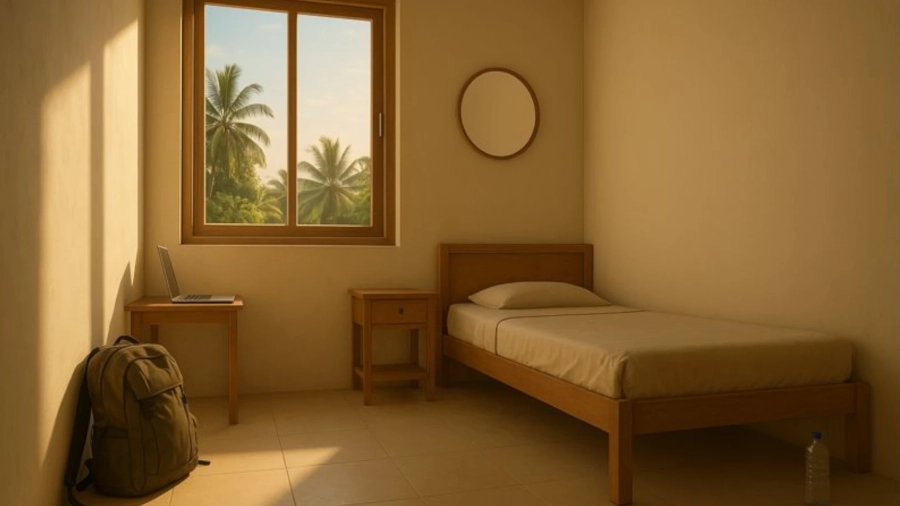
My room has a double bed, two bedside tables, a small wardrobe and a mini table mounted on the wall. I almost forgot: there’s a mirror here too. Double luxury.
Oh, and there’s a TV, which I’ve never turned on.
These few things fit in this room in such a way that I can walk around the bed on three sides and do push-ups and squats in front of the door. Burpees won’t fit in it anymore – I’ll do that in a bigger apartment.
Oh, and there’s no window in the room. There’s a half-window next to the door, but I always keep the curtain drawn in front of it. It looks out onto a half-meter-wide corridor anyway, so I wouldn’t be depriving myself of much light.
The whole thing feels a bit like a prison. The lack of sunlight, for example, gives it this vibe quite a bit.
Despite all this, I really like this room.
But when I got home, I had a few thoughts: this isn’t for everyone. Claustrophobics won’t be enlightened here.
Last week, I brought home dinner from a fancy Japanese restaurant and ate it standing in front of the mirror on my small table. The box just fit next to my laptop. I wanted to buy some soup, but when it turned out that I had to pour hot water on it at home, the plan failed.
Because I don’t have a kitchen. I don’t have a kettle. And I wouldn’t drink hot water from the tap even if I did.
So I struck home-made soup from my menu.
I always have to share my table with a few curious ants. Sometimes I feel sorry for them, because they don’t have much food to count on. I don’t have a refrigerator, so I only buy fruit. I put that on the top shelf of the cupboard, because I don’t feel sorry for them enough to give them some.
For example, yesterday I bought a small watermelon. Then I smiled: December 10th, and I’m carrying a melon home. Bali, you’re amazing.
I already had the feeling at the market that since I don’t even have a knife, cutting the melon would be a Herculean task. I thought that nail clippers would solve the problem. On the way home, I let go of this idea – but oh well.
Then in the evening I switched to MacGyver mode. The challenge: to get to the red part of the melon with the available “tools”. My best idea was that the bottom edge of the sunscreen tube might be sharp enough to cut the melon rind.
It wasn’t sharp enough.
I managed to achieve this by digging a ten-centimeter, a few millimeters deep trench into the rind. I could squeeze my fingers into it, and finally tear the fruit in two.
Which was half bad, by the way, so I could only eat it with a few spoons. If you’re wondering and say that I’m caught: the spoon is for the Japanese dinner. It’s a lightweight, disposable piece of plastic. So I was worried about it breaking the whole time I was eating the melon dinner.
This is not Thailand.
I don’t have two spoons here anymore…
And from now on, I’ll leave it to everyone’s imagination to decide whether I have a right to repeat for the third time that “I thought a few times that this isn’t for everyone.”
Before we go out the door and take a look around the outside world, one more thought about the room.
I got used to having my own gecko in my room and bathroom on the first island. That’s why it doesn’t surprise me much when I get home and the little creature falls down because it was frolicking in my bed, and then tries to act like nothing happened.
The feeling is also familiar: if I lift something, I’m not surprised if someone jumps out from under it. That’s also part of the package.
So I live the minimalism of lack of tools by sharing it with others.
And as I experience all of this—from the cold water to the crackle of the plastic spoon, to the intimate living space of the gecko, to the people hiding under the things in question—I’m somehow left with one feeling: it’s all simultaneously absurd, funny, strangely homey… and totally okay.
In a strange way, here in this tiny room, through deprivation and improvisation, I’ve begun to truly understand what it means to live a minimalist life.
The textbook definitions have lasted so far. From here comes another level.
What does my personality say? What does minimalist living mean to me?
The essence of minimalist living is very simple – and at the same time incredibly liberating.
Minimalism is not about having less stuff.
It’s about having only the things around me – and in me – that truly serve me.
This is exactly what I’m experiencing right now in Asia: less doesn’t mean lack, but space.
Space to breathe, to make decisions, to be light.
For me, minimalism = conscious focus.
- fewer objects,
- less noise,
- less obligations,
- less “shoulds”.
And instead:
- more presence,
- more freedom,
- more choices,
- more inner peace.
Minimalist living tells me:
“Things don’t own me, I decide what I put my energy into.”
Minimalism isn’t about objects, it’s about the inner lightness I feel when I finally have no unnecessary weight around me. Neither physical nor mental.
Digital nomad minimalism – how I live it
Few objects, lots of room for movement
I already live this life:
- one backpack = everything I need,
- no unnecessary “home” to carry,
- wherever I sit, my desk is there.
This kind of minimalism does not bring a feeling of “nothingness”, but the subtle realization: It is not my stuff that gives me identity, but who I am.
Mental minimalism – the most important new thing
This is what has become especially strong in me in the past few weeks.
My minimalism is actually this:
- I no longer carry the old roles,
- I have put down the burden of “what I should be doing”,
- My relationships have been cleared,
- I have created space for who I am now – and who I have always been.
Everything is whispering: Let go of what is not you!
Emotional minimalism, pure connections
Nomadic life has taught me that for me, connection = happiness.
And this means in minimalist form:
- only real connections remain,
- no compulsion, no conformity,
- whoever comes can come freely; whoever goes can go freely.
Minimalism does not say: “fewer people”. It says: “Only real people.”
Temporal minimalism
Finally, I feel that time is no longer my master, but my companion.
My temporal minimalism looks like this:
- I only take on what resonates,
- no overload,
- neither the past nor the future is pulling,
- the present is the main stage.
This is the flow I often talk about, which I am now achieving more and more easily.
Sometimes I feel like I am in this state all the time.
Spiritual minimalism
My return to my roots…
This is the level where I no longer have many words.
Here:
- my superfluous identities fall away,
- my intuition guides,
- decisions come from my feelings,
- and suddenly I say to myself:
I have arrived.
This minimalism is not about principles.
It is about finding home.
The essence of my nomadic minimalism is:
there is nothing left to separate me from who I am.Buy me a coffee?

If you enjoyed this story, you can buy me a coffee. You don’t have to – but it means a lot and I always turn it into a new adventure.
Buy a coffee for Steve
 Linktree
 Short introduction