
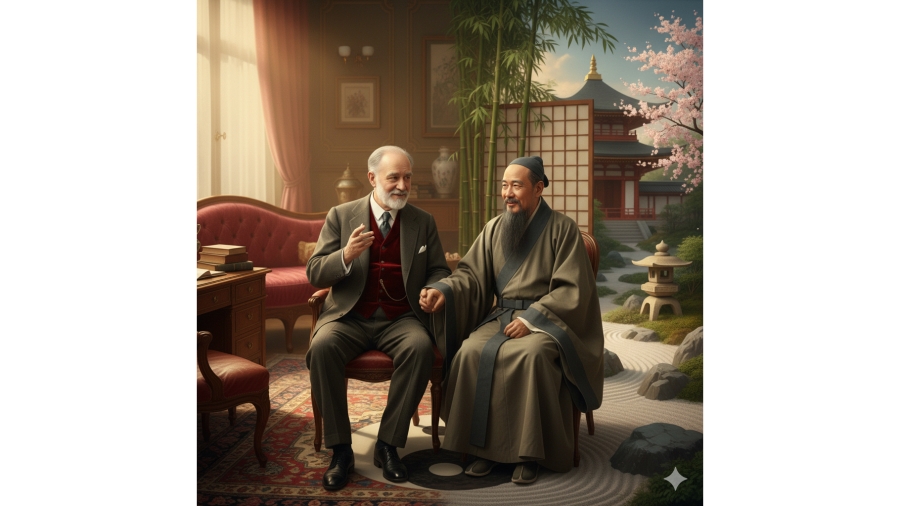
Western psychology and Eastern spirituality seem at first glance to be two separate worlds. One is based on the objectivity of science, empirical studies and experimental results. The other is based on the inner experiences of millennial traditions, the depths of the soul and the transcendent dimensions of human existence. Many believe that these two perspectives are at odds with each other, when in reality they not only complement each other, but also naturally form a complete picture of man.
László Buda’s line of thought also highlights that the different trends in psychology all point in the direction that the unity of body, mind, emotions and soul cannot be separated. For example, the body is not just a biological machine, but the carrier of life history, the imprint of the subconscious, in which all past experiences vibrate. Eastern traditions teach similarly: the body is the arena of energy and consciousness, which we must nurture just as we do our hearts and thoughts.
Stress psychology highlights that one of the greatest challenges of modern man is to release tension and experience emotions freely. This almost literally echoes Buddhist or Taoist teachings, which emphasize the importance of inner peace, meditative presence, and emotional purification. Western researchers call it “stress management,” Eastern sages call it “letting go” or “non-attachment,” but the goal is the same: restoring harmony.
And when positive psychology focuses on the positive aspects of human existence, it actually points to the same inner source that spiritual paths call gratitude, love, or awareness. This is where the two approaches really come together: scientific psychology measures and models with tools, and spirituality experiences through experience, yet they reveal the other side of the same reality.
Holistically
If we look at the human being as a holistic system, four fundamental dimensions emerge: body, heart, mind and spirit. These are not separate islands, but interconnected, interacting systems. Western psychology is increasingly recognizing that emotional and thought patterns lie behind physical symptoms, while Eastern philosophies have long taught that without a clear mind, the body cannot fully heal. The two traditions therefore do not oppose each other, but rather move side by side, and together they provide a complete picture of human existence.
The first level of the “basic recipe” is related to the body and the physical environment: proper nutrition, breathing, movement, rest and caring for the environment. This is in complete harmony with Eastern practice, where yoga and tai chi respect the body as a temple of the spirit. The Western perspective here is perhaps more practical, thinking in measurable parameters, while the Eastern perspective considers the body as a scene of energy flows – however, both perspectives call for the same thing: respect and care for the body.
The second level is the world of emotions and relationships. According to modern psychology, unprocessed anger, guilt, or shame can lead to illness – according to Eastern teachings, these emotions form “energy blocks” that hinder the flow of life. Whether we call it “psychodynamics” or “karmic imprints,” the essence is the same: the condition for healing is to let go of emotions and build loving relationships.
The third level is the sphere of thought and information. Western psychology here talks about belief systems and cognitive distortions, while Eastern philosophies teach about “purification of the mind” and “right vision.” The words are different, but the direction is the same: to free the mind from blocking patterns so that clearer, more serene thoughts can take their place.
Finally, the fourth level is the soul and the divine dimension. This is the area where Western science and Eastern spirituality seem to be the furthest apart—yet it is here that they can be most deeply intertwined. Transpersonal psychology, for example, openly integrates spiritual traditions, while meditation and prayer have been a mainstay of Eastern paths for millennia. Whether we call it “self-realization” or “enlightenment,” the goal is the same: to discover and experience the wholeness within us that connects us to the universe.
So if we view our bodies, emotions, thoughts, and souls not as separate entities but as a unified system, then Western psychology and Eastern spirituality almost automatically meet. The difference between the two lies more in language and emphasis than in substance. The tools of science and the paths of inner experience point to the same thing: how to maintain balance, how to heal ourselves, and how to connect more deeply with the world and ourselves. The question, therefore, is not whether the two perspectives are “compatible,” but rather how we can experience and integrate this wholeness in our everyday lives.
László Buda
The idea for this post came to me after reading László Buda’s book: What is your body telling you? I wholeheartedly recommend the book to everyone. I also received the recommendation from a friend, and for that I have been grateful ever since!
I hope László Buda will forgive me for quoting from his book – with the greatest respect. I hope that the intention is not to violate the law, but to show good intentions. Once again! I wholeheartedly recommend the book to everyone! There is much more to it than the few lines of thought I have picked out.
First, I quote a summary from the author, which summarizes the schools of psychology. This is interesting to me not only because I am interested in psychology, but also because the sentences naturally contain the characteristics of the two approaches.
Then we learn about four ways to understand the things of the world.
Finally, we get a “basic recipe” from the excellent author.
Verbatim quotes follow, from here on I will not speak.László Buda – Psychology schools
Let me mention some schools and trends in psychology, without claiming to be exhaustive, that have influenced my thinking. These are the most essential intellectual sources and foundations of my later work. I will express in my own words what they have told me.
- Somatopsychology – The human soul is encased in a body, and it is worth paying attention to this body when dealing with mental problems. The body works largely automatically, preserves the entire life history, and is inextricably intertwined with mental processes. The body itself is the unconscious (or in more common language: the subconscious).
- Stress psychology – The greatest challenge facing modern man: reconciling the external and internal worlds, processing information dumping, releasing tensions, freely expressing emotions, and coping with conflicts. Most diseases are somehow related to insufficient stress management.
- Positive psychology – By replacing the pathology-oriented psychological paradigm, it brings the forward-looking aspects of human existence into the spotlight. This gives space for consciousness to use the energy of attention to strengthen the processes that point towards health.
- ASC psychology – A collective term for the schools of thought that work with altered states of consciousness. From ancient shamanic trance to yoga, hypnosis, relaxation techniques, brain control, NLP, and meditation, many methods are based on the observation that special abilities of the mind (such as memory, visualization, creativity, self-healing) can be more easily exploited by achieving special states of consciousness.
- Energy psychology – Attempts to merge Eastern energy theories with Western psychological approaches. It posits the body as an energy system, thinks in terms of vibrations and frequencies, and connects psychotherapy with the manipulation of chakras, meridians, and specific acupuncture points.
- Quantum psychology – It seeks to embed physical principles such as “quantum leap”, “string theory” or “parallel universes” in a psychological and therapeutic context. According to this method, by becoming aware of the special relationship between the observing subject and the observed object (for example, our own body) and by modifying the “reality projection”, we are able to generate leap-like changes in our physical and mental health.
- Transpersonal psychology – By embracing the integration of spiritual traditions, it paves the way for the broadening of the psychological horizon. The roots and foliage of the human soul far exceed its individual being. Everything in our world is permeated by the operation of the intelligent spirit.
- Integral psychology – A grandiose attempt to include all these thoughts, principles, traditions and methods in a unified framework, a worldview, which can be a psychological, philosophical, scientific and spiritual reference point for the seeking person of today.
I hope you agree with me: in the 21st century, the only possibility is the integration, acceptance, and mutual fertilization of disciplines. Philosophy, physics, biology, biochemistry, medicine, and psychology, now allied with each other, can answer the great, current questions of humanity with an open mind to religious, intellectual, spiritual, and artistic aspects.
László Buda – 4 way
There is an idea in psychology – perhaps first explained clearly by Jung – that we can approach understanding the world, experiencing our relationships, and making our decisions in four fundamentally different ways:
- through the channels of sensory perception,
- feeling (emotion),
- thinking (cognition)
- and intuition.
Simply put, there are
- the sceptics (“I’ll believe it when I see it”),
- the sentient beings (“you can only see clearly with your heart”),
- the wise men (“is there a scientific basis for it or not?”)
- and the wise men (“the angels whisper that…”).
Of course, I tried to make the typology ridiculously narrow – we all operate all four processes in some proportion.
László Buda – “Basic Recipe”
If we admire the human being as a holistic system and examine its functioning in four dimensions (body – heart – mind – soul), and then further break these four dimensions down into external and internal subsystems, we get a fairly simple basic recipe for what health maintenance and self-healing means and consists of. Please read the basic recipe through, not to find something new in it, or to start wondering what is missing from your life right now, or to get annoyed by the idealized list, but only so that we have a common denominator. To summarize what the most famous healers in the history of mankind have preached, and which – somewhere inside – you and I are both aware of, even if we cannot realize it…
The basic recipe:
I. The level of the body and the physical environment
1. Caring for and healing the body: Proper nutrition, breathing, exercise, rest.
2. Shaping the environment: Good quality food, avoiding toxic environmental influences, proper housing conditions, closeness to nature, order, beauty, cleanliness, safety.
II. The level of emotions and relationships
3. Experiencing and healing emotions: Resolving and releasing sickening emotions (for example: anger, resentment, guilt, shame), experiencing filling, energizing emotions (for example: joy, enthusiasm, gratitude, love) as often as possible.
4. Shaping relationships: Resolving our conflicts, resolving dependencies, building loving, honest, mutually interdependent relationships.
III. The level of thinking and information
5. Purifying and healing thinking: Getting to know our own belief system, convictions and thoughts as completely as possible, letting go of unnecessary, harmful, disease-causing, and obstructive parts, strengthening sober, clear thinking.
6. Shaping the information environment: Continuous, enjoyable learning. Searching for information (books, teachings, trainings) from which we draw strength and momentum, and which orient us towards health, dismantling unnecessary or harmful information (such as certain TV programs, news that cause concern and fear).
IV. The level of the soul and divine quality
7. Finding the soul: Awakening to self-awareness, discovering a personal mission, finding inner peace, starting on a spiritual path.
8. Merging into the divine quality: Recognition of the unity of the external and internal, deep harmony with nature, the universe, or – if you like – with God, your personal image of God.
Whoever follows this program will be able to maintain their physical and mental balance even in difficult circumstances, will encounter few illnesses, and will recover quickly from them.
Buy me a coffee?

If you enjoyed this story, you can buy me a coffee. You don’t have to – but it means a lot and I always turn it into a new adventure.
Buy a coffee for Steve
 Linktree
 Short introduction