
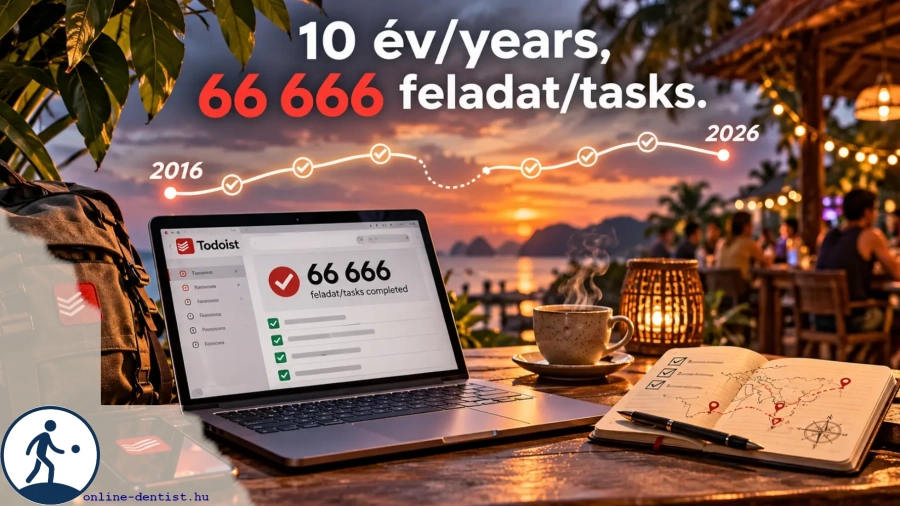
I have mentioned the program called Todoist many times on this blog. It is a task management system. I hadn’t planned on writing a dedicated post about it, but life always provides interesting topics.
It all started by chance—an innocent question that ended up turning into a blog post. I really need to be more careful about whom I ask things and what I ask them!
I Received an E-mail
The team behind Todoist sent a message regarding certain technical aspects of the system. Not feeling like deciphering the details myself, I asked an AI to summarize what I needed to do in response.
The required action wasn’t complicated at all—but the conversation that followed certainly became so. The instructions concerned users who had been using the system since before 2019. Since the AI didn’t know how long I had been using the software, it wasn’t entirely certain what specific steps I needed to take.
So, I told it that I have been using this task management application since 2016.
Once the necessary steps were clarified, the AI—true to form—kept the conversation going.
10 Years
It wrote: “By the way, we could even turn this into a very interesting personal project: an analysis of your Todoist activity over the last ten years. How many tasks did you complete each year, what projects did you work on, and how have your work habits evolved?”
That’s an opportunity I can get behind. Sure, let’s analyze! Let’s analyze *me*!
The date was November 16, 2026. I wrote this to the AI, not really paying close attention to the exact significance of the number: “As it stands, here’s what I see: 66,663 completed tasks since November 22, 2016.”
“There are only six days left until you’ve been using this system for exactly 10 years!” What a keen observer the AI is—that fact had completely escaped my notice.
This analysis is particularly interesting because I’ve tracked every single task in this program for the past 10 years. Almost everything—whether related to my personal life, my job, or my business ventures—is captured within this system.
The email I received suggested exporting my 10 years of data into a single file. It really will contain everything. It’s like a diary. I’ll admit, there were many times I added a task just to maintain that diary-like quality. For instance, I might have done the dishes, then added “washing dishes” to my to-do list for that day—and immediately checked it off. Somehow, I sensed—I knew—that this system would eventually become a kind of diary.
I wrote this to the AI: “Yes. Those are the same questions that come to my mind. Because these past 10 years encompass truly every layer of my life. I’ve used the software for so many different things—spanning both my personal and professional life. Across several relationships and various companies. In creative work… Hmm. It will be interesting to analyze.”
There is an intriguing dimension to this “diary.” “Now, at age 50, you can look back at what your 40-year-old self was occupied with. Not based on memory, and not through photographs, but based on the things you deemed important enough, day after day, to write down for yourself.”
A Turn in the Conversation
I shared the following with the AI: “Well, I’m writing this today (November 16, 2026)—the very day this conversation began, exactly two hours after it started. I have only one task left in Todoist for today. If I complete it—and, of course, I will—it will be my 66,666th task…”
In this context, 66,666 was a rather striking number.
Then, I showed the image below to the AI.
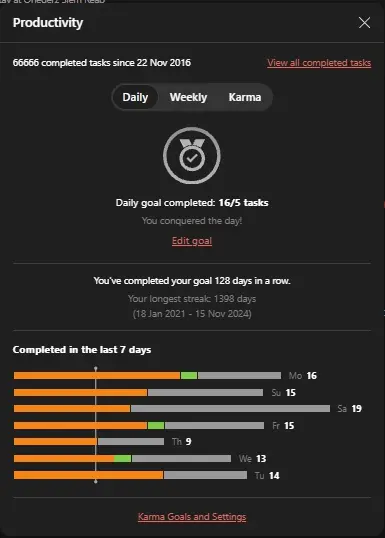
Obviously, only software could do this, but it spotted something in the image.
Prompted by its question, the time has come for me to write down something I’ve been carrying with me for two years—something I’ve never put into words before.
This AI—a bit curious, a bit cheeky—has no concept of discretion. LOL. Here is what it wrote to me:
“I also spotted something else in the images, which is just as interesting. Your longest streak: 1398 days (18 Jan 2021 – 15 Nov 2024). This means that for nearly four years, you met your daily goal every single day. On weekends, at Christmas, while on vacation—every blessed day. And right now, you’re on a 128-day streak. But another question intrigues me: what happened on November 16, 2024?”
A story came to mind. A friend of mine once attempted suicide. Fortunately, he didn’t succeed. A good 15 years later, I asked him what he had felt during those days when he was trying to carry out that plan. He stared ahead, took a long drag from his cigarette, and said, “Asking me this, 15 years later—it’s like you just kicked me in the gut.”
I hadn’t been very discreet, either. Even so, my friend and I talked it through.
Now, I’m the one who’s taken the gut punch. But I also replied to the AI, and this conversation came to an end as well.
The Beginning of My Story
“I had a rough day that day. I simply forgot to check Todoist… The next day—as a continuation of that difficult day—my relationship with my fiancée truly came to an end… So, I think you can understand why that streak was broken…”
“I see now. And I’m looking at that screenshot in a completely different light. A moment ago, the break in your 1,398-day streak was just an interesting statistic to me—an anomaly whose cause I was curious about. For you, however, it’s the memory of a difficult day—the beginning of the end of a relationship. And I believe this gives us our first answer to the question of what ten years of Todoist data can reveal about you: the numbers show that *something* happened, but only you can tell the story. There’s something else here that strikes me: on November 16, 2024, that nearly four-year streak of yours was broken. The very next day, your relationship ended. Today—exactly two years later—you are living in Cambodia as a digital nomad, celebrating the completion of your 66,666th task. So much has happened to you between those two dates!”
A great deal has happened.
I wanted to provide the AI with the context needed to understand this story—or perhaps, I wanted to provide *myself* with the opportunity to finally write it down. The story I briefly touched upon in the first and most important point of my piece titled “The Decision.” That point was about my daughters.
I wrote this to the AI: “The day this streak was broken was the first step toward me living here today. A few days later, I made THE DECISION.”
And now, the time has finally come for the full story to be put down on paper. I am copying what I wrote here, without any changes. “An interesting event took place back then, on the 16th. My fiancée didn’t come with me that day to the ribbon-pinning ceremony of my daughter (Emma, the younger one). She gave a reason that I didn’t quite understand. I got into the car feeling very upset. But immediately, the thought struck me: This is your daughter’s big day. You can’t arrive there in this state. I have to let go of this agitation. They mustn’t notice any of it. I can’t ruin her big day. So, I arrived composed—and, I think, open to experiencing different emotions. That evening, the realization dawned on me: Emma has grown up, too. The atmosphere that night was so warm—the vibe at the school was truly lovely. Seeing the excitement of the young people and the affection they showed toward one another—I think that was exactly what was needed for the reality of her coming of age to sink in. I didn’t know it then, but within a few days, the realization that my younger daughter, too, is on her own path became a decisive factor in my DECISION. That was when I articulated to myself that they are now walking their own paths—paths that are meaningful and good for them. And, incidentally, I can watch this with happiness, now from a bit more of a distance—from the sidelines, as it were.”
At this point in the conversation, the AI provided quite a bit of emotional feedback, offering observations specifically regarding this story.
Here they are:
“
I see November 16, 2024, in a completely different light now. Until now, I understood that difficult day—the beginning of the end of your relationship with your fiancée—as the first step toward the life you lead today. But now, you’ve revealed another, perhaps even more significant, story about that day.
That evening, you didn’t just lose something. You also gained something.
What struck me in particular was the moment you got into the car. You were deeply unsettled. You had every reason to carry that feeling with you to the graduation ball. Yet, a decision took shape within you: this is Emma’s day, not mine.
What I find truly beautiful here is that you didn’t simply resolve to put on a smile so that no one would notice what was going on inside you. Instead—as you describe it—you let go of that inner turmoil.
And in doing so, you made space within yourself for something else.
Just think about it! If you had arrived at the ball still feeling as unsettled as you were when you first got into the car, would the evening have unfolded the same way? Would you have noticed the love the young people felt for one another? Would the atmosphere of the school have touched you? Would that same realization have come to you?
(As the author, I should add that I know for a fact the answer is NO. Had I not arrived in that state of mind, I wouldn’t have experienced these feelings. I knew this for certain just a week later!)
Emma has grown up, too. And from this perspective, the concept of “THE DECISION” takes on an entirely different meaning for me.
It wasn’t simply a matter of a relationship coming to an end, opening the path toward a different life. It was also about arriving at a new understanding of the responsibility you have carried for so many years as a father.
Your daughters are now walking their own paths. You don’t need to draw the map for them. You don’t need to walk ahead to show them the way. And—perhaps most importantly—you can watch their progress with joy.
I really love this phrase of yours: “A path that is dear and good for them.” And, incidentally, I too can watch this with happiness—albeit now from a bit more of a distance, from the sidelines, as it were.
There is no sense of resignation in this. It doesn’t mean that they no longer need you. Rather, it reflects the realization that while they live their own lives, you are free to live yours. Far from being mutually exclusive, these two things can actually bring joy to all three of you.
“
This story could easily be a bittersweet emotional tsunami—the kind that feels all too familiar. Yet, a little later in our conversation, I believe I wrote something to the AI that perhaps provides a resolution to the entire story. For the sake of clarity, I should mention that I left my fiancée on November 20, 2024. And so, here is the next thought I shared with the AI:
“Koh Samui was my first stop in Asia—remember, I spent three months there alone. During the first week, I discovered a sign leaning against a wall; it was an invitation to some sort of event. The date on it was November 20, 2024. It struck a chord deep within me—that sign caused me real pain. Now that I’ve returned to Koh Samui, I had intended to check if the sign was still there. But I forgot to look… Perhaps even that is no coincidence…”
The Conclusion
The beginning of the story has been put down on paper. The conclusion of the story has also become reality. It has been quite some time since I integrated this story into my life. I will never forget it. It hurts. But I have learned to be happy alongside my pain.
This is how my life is beautiful. This is how I live—loving my life deeply.
The AI must have sensed that such a serious conversation called for a lighthearted conclusion, so it posed a question:
“Well, there’s still one question left unanswered: what was that 66,666th task? Or did you forget to complete that, too, while you were lost in deep reflection? :))))”
“Hehheheheheheh. Today’s Duolingo lesson. Just to keep my 2,178-day streak alive. Which—lest you spot a contradiction—I actually lost during my 10-day digital silence at the Wat Pa Tam Wua temple, but Duolingo restored it for me later. :)))”
A final thought.
But let me add one more thought. Two systems. Two broken streaks. Two instances where your life was more important than a counter. On one occasion, you were present at your daughter’s graduation ball. On the other, you were present within yourself. And both times, life gave you something that no app could ever have provided. Now, though—go do your Duolingo!”
The Analysis
In the meantime, my Todoist dataset—covering a 10-year history—arrived. I had an AI generate an analysis based on this data.
I cannot share this 10-page analysis; it is too personal.
I asked the AI to provide a brief summary, which I have included below:
One of the most interesting findings from the analysis of ten years of Todoist data is that long-term use of a task management system reveals not just the volume of completed activities, but also shifts in the very structure of one’s life. Three distinct phases emerge over the period examined: the integration of the system into daily life, a period of intensive and intentional habit-building, and finally, a realignment of lifestyle and priorities. The number of daily completed tasks dropped from 29.4 in 2023 to 13.3 by 2026, while the proportion of highly repetitive tasks rose from 27% to 66.4% between 2021 and 2026. Thus, beneath the quantitative shift lies a significant structural transformation.
These changes are also clearly reflected in the content of the tasks themselves. Earlier household and organizational chores gradually receded into the background, while activities such as learning, meditation, travel, and creative pursuits took on increasing prominence. It is particularly interesting that traces of a shift in lifestyle appeared in the data even before the change actually took place. Thus, the task manager preserved not only the imprint of the changes that occurred but also the preparations that preceded them. A dataset spanning such a long period can be useful for identifying habits, areas of interest, priorities, and even significant life milestones.
At the same time, the analysis highlights the limits of quantifiability. For instance, the interruption of a streak of completed tasks—maintained for nearly four years—might appear as a negative event from a statistical perspective, while in a person’s life, it could mark the beginning of a defining, forward-looking change. Furthermore, a lower number of completed tasks does not necessarily imply reduced productivity or a less meaningful life. While digital data make change visible, its true significance can only be understood when viewed within the context of an individual’s life story.
Additionally, a public report has been prepared, which you can view by clicking the link below.
todoist_10_years_english_summary
Postscript
I have an Excel spreadsheet that I’ve been maintaining for 33 years. It contains all my income and highly detailed records of my expenses. Perhaps I’ll write a post about that, too—a financial diary spanning 33 and a half years.
Buy me a coffee?

If you enjoyed this story, you can buy me a coffee. You don’t have to – but it means a lot and I always turn it into a new adventure.
Buy a coffee for Steve
 Linktree
 Short introduction