
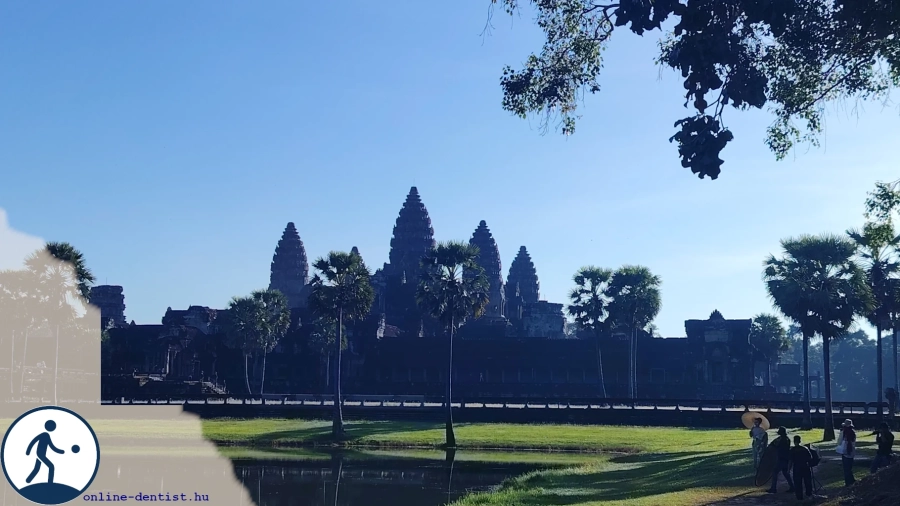
I felt a bit like I did in Chiang Mai at the end of January.
If someone were to ask what I did for two days, the answer might be similar to what I reflected on in my piece titled “Changthong Heritage Park: Chiang Mai’s Green Museum.”
For two days, I looked at stones. 100 million tons of stones. That’s it.
Alright! Obviously, there was more to it than that in Angkor.
Statistics
What can I say? I love numbers. Let’s start with a simple assessment.
Distances.
The two-day plan looked like this:
- Thursday: Estimated walking: 21–24 km. Cycling: 14–18 km.
- Friday: Estimated walking: 16–19 km. Cycling: 14–18 km.
Here are the actual figures:
- Thursday: 29.2 km walking, 19.4 km cycling.
- Friday: 22.1 km walking, 15 km cycling.
So, I managed to exceed my plans. LOL.
Media files.
I didn’t have a specific target for how many captures I’d make. I did suspect, however, that I’d be using my phone quite a lot.
Here are the actual figures:
- Thursday: 1,259 media files (1,214 photos, 45 videos)
- Friday: 931 media files (900 photos, 31 videos)
A few more interesting numbers from the story of these two days:
867 rejected offers—for taxis, clothing, coconuts, etc. 67 moments of “I’m lost, I have no idea where I am.” 917 moments of smiles, friendliness, and genuine human connection. 1,654 beautiful trees admired. 3–4 tentative, gentle touches of brick walls. Two long sunrise videos. One long sunset video. Dozens of thoughts on the verge of the realization: “you’re not normal.”
One item checked off the bucket list.
And countless other experiences. I will attempt to summarize these two wonderful days. I’ll try to tally up the number of buildings I saw as I write, though I suspect that even in retrospect, I might not be able to give an exact count.
I knew beforehand that these would be two very long and demanding days. For that reason, I didn’t burden an already strenuous schedule by trying to write about it while on the move. Instead, my approach will be to look back through my photographs and piece together the thoughts that surfaced during those two days.
A quick note: this will be an unconventional post. I realize that readers often look forward to seeing images; however, these two days were so intense—and I saw so much—that I simply cannot take on the task of curating photos to accompany my descriptions. That said, I will include the names of the locations, allowing you to follow my journey online. I invite you—if you’re interested—to take an active part in the process by using a search engine to explore further.
Upon finishing this piece, I realized that, after a while, the churches begin to blur together. You will encounter themes that recur throughout: sheer monumentality, steep staircases, intricate carvings, moments of getting lost, and the constant realization of how much more there is left to see. I feel I’ve reached the point where I could no longer take in more wonders with the same intensity. It’s not my most polished piece of writing. Yet, I still love it.
Thursday
Thursday began with two instances of forgetfulness on my part.
First, I had forgotten the final task from Wednesday: “I have just one thing left to do regarding the trip—I need to secure a bicycle for the next two days.” It hit me at 8:00 PM that I was missing my “steed” for tomorrow’s ride. The advantage of places like this—true tourist havens—is that, just 20 minutes later, I was already pedaling home on a beautiful yellow “horse.”
The second lapse in memory caught up with me while I was on the bike. I had prepared everything earlier that morning, before going to sleep—except for a sarong. I was planning to visit some churches, but I was wearing shorts that didn’t cover my knees. I had to turn back. You can actually see this detour reflected in the statistics. LOL. Meanwhile, I was worried sick that I would miss the sunrise.
I didn’t miss it. The sunrise happened, though without the Sun itself. You see, I had found the perfect spot for my phone, set it up, and started recording. I filmed the sunrise for 50 minutes; this will eventually become a 26-second video for my “Happiness Is Already Here” series. What makes this footage interesting is that the Sun isn’t directly visible—it didn’t rise where I expected it to, but rather a bit further over—specifically, just outside the frame of my phone’s camera. Still, the result is beautiful. And just like that, the 50-minute morning meditation to kick off the day was done. I’ll actually write more about that later on.
I’ve gotten a bit ahead of the story—it’s still only dawn, after all. On the way, I spotted a sandwich vendor and decided to grab a quick breakfast. The old man making the sandwiches didn’t speak English, and I don’t speak Khmer, so we had to rely on gestures. I signaled that I wanted one sandwich—using a raised index finger. (In Hungary, the conventional sign for “one” is a raised thumb.) I wasn’t the least bit surprised when, despite my clearly raised single finger, the old man prepared two sandwiches. Maybe he figured I could handle two, or perhaps he knew I had a long day ahead. Or maybe he was just seeing double. It doesn’t matter. I ate one of the sandwiches right there, and the other while spending 50 minutes filming the sunrise. They were incredibly delicious—though the onions inside stayed with me all day long.
Phnom Kel
The first temple I visited was not Angkor Wat. In fact, it wasn’t even a temple. Phnom Kel is an ancient hospital building—or rather, what remains of one.
It is a small structure—a mere fragment, a shed-like remnant compared to the wonders I had seen over the previous two days. Yet, it will remain memorable to me—perhaps forever. It was, after all, the first structure I saw up close within the Angkor complex. It was through this site that I began to discover the wonders amassed in this part of the world.
Angkor Wat
The second temple I visited was Angkor Wat. My plan for the day was simply to walk through it, moving from west to east. But even just passing through a temple like this is no simple task; there is so much to see, even along the main path. I almost lost track of time entirely. At one point, I realized I had strayed from the direct route. I reminded myself: I’ll spend more time here tomorrow.
This walk—which could hardly be called short—was enough to bring a lump to my throat more than once. Even while filming the sunrise, I found myself covering my face, thinking, “I can’t believe I’m actually here.” Inside the temple, that feeling became even more intense.
Compared to the first structure I visited, this temple lies at the complete opposite end of the spectrum. It is massive. Breathtaking. It features an abundance of corridors, windows, and staircases—all designed for functions that remain a mystery to me. As I observed elsewhere over the course of two days, the temple was built with the utmost respect for symmetry. If I explored one side of a section, I could already mentally picture the corresponding side.
Yet, neither side is ever boring. There are statues, figures, and stories carved into the walls. There is the sheer, awe-inspiring scale, contrasted with delicate, intricate details—the weathered surfaces of the original stones, alongside the visible signs of restoration. Old, black stones, accompanied by their replaced, cleaner counterparts.
The entire site is a remnant of a bygone era. Yet, in some way, it felt remarkably alive—and not because of the throngs of tourists. The active water-filled moat surrounding the structure, the verdant garden, the surrounding trees, and perhaps the timeless dignity of the place itself, all suggested that it was still living. I half-expected someone from that past age to step out from behind one of the corners.
Occasionally, I caught snatches of what the tour guides were saying. I was enjoying the setting, but I eventually moved on, as a walk of about 6 kilometers lay ahead of me to reach the next destination.
Lok Ta Ku (East) Hermitage
The Lok Ta Ku (eastern) hermitage is a local place of worship, constructed at the eastern gate of the central complex. The structure also serves as a shrine to a guardian spirit (*Neak Ta*).
It was here that the true nature of the Angkor site began to become clear: buildings are packed so closely together that one structure practically gives way to the next.
All a traveler needs to do is stand in awe—mouth agape—and listen to the whispers of spirits from ages past. In places like these, the imagination is free to take flight.
Mine, at least, certainly did.
Kravan Temple
My two days were defined by improvisation—or, to put it another way, by flexibility. This church was not part of my original plans.
Now, as I write this, I realize that of the first four buildings I encountered, two were not in my plans at all.
This church is tucked away in the woods beside the road. It allowed me to film a scene for one of my videos: a weary traveler emerging from the trees to discover such a magnificent structure. The church stood in the middle of a clearing, with a lake nearby—and on the lake’s shore, cows grazed peacefully. Standing behind the building, there wasn’t a single trace of the modern world to be seen. In a way, I had—quite by accident—embarked on a mini journey back in time.
There was a delightful silence, a sublime view, and not a human soul in sight. I made friends with the cows, marveled at the stones, and photographed the lake and the trees. I spent some truly wonderful moments here.
Nameless(?) Church(?)
Actually, there are two things I’m not sure about here—even in hindsight. Or, rather, three. The “nameless” part is definitely not accurate; whatever I saw surely has a name. It’s just that this thing doesn’t appear on any map.
Based on the information from my photographs, I checked the map—nothing is marked there. Yet, this thing was definitely there; I walked alongside it in the forest for over a kilometer.
Another thing I’m unsure about is whether it was actually a church. It’s possible I was just walking past an old wall—I didn’t really see any actual buildings. As it stands now, in 2026, it looks as if someone built a long wall right in the middle of the forest. Maybe a stonemason was practicing here? I don’t know.
A third uncertainty is whether what stood here was truly a church. It could have been a barracks. Or a bakery. This place is full of mysteries—even on a Saturday.
In any case, I do remember that walking alongside the wall was a captivating experience. The wall still stands with a sense of dignified guardianship. It had collapsed in only one spot—I even filmed a video there, which I plan to title “The Stone Walls Crumble.”
Another thing I experienced while walking here was the scent of flowers. The fragrance of so many blossoms was so exquisite that it was almost intoxicating. In only one spot—over a relatively short stretch—did I detect an unpleasant smell of cat urine. Both sensations were baffling, as I saw neither flowers nor cats among the beautiful trees.
I’m telling you! This place is full of mysteries. Even on a Saturday.
Banteay Kdei Temple
There was a little twist here, too.
While wandering along, I happened to notice a temple—one that wasn’t part of my original plan. So, I decided to explore it thoroughly.
To give you an idea of its scale, let me share a quick detail: when I reached the far end of the temple, I turned back to return to my planned route—meaning I essentially traversed the entire length of the temple twice. The building’s spine is a long corridor. I decided to record a video of myself walking the full length of this straight stretch. I don’t usually walk slowly, and I certainly didn’t this time, yet the walk still took me two and a half minutes. In short: the temple is quite large.
But what was that little twist I mentioned?
This temple was actually on my itinerary for the day—it was just intended to be the very last one I visited. So, what happened? It simply crossed my path, just from the opposite end. I walked through it—entirely on my own initiative, and outside of the original plan. Then, at the end of the day, I arrived here again, this time from the other side. Upon entering, I was delighted to discover this temple anew; viewed from this angle, it felt like entirely uncharted territory. As I stepped inside, I was met by a Buddha statue and a sign asking visitors to remove their shoes. That was when it hit me: I had already seen this place earlier today…
Perhaps this is what they mean when they say: “Man proposes, God disposes.”
It was in this temple that I began to feel that, despite the symmetry, the whole place is something of a small labyrinth. Although the walls are laid out at right angles and doors open to the left and right, the complex is full of walls and turns. Consequently, after wandering around a bit, it’s easy to lose your bearings. It doesn’t hurt to have some local knowledge up your sleeve—or at least a compass.
This is where I first encountered “Angkor-style Lego.” Throughout the site, there are many references to the extensive restoration work that has been—and continues to be—carried out here. It is truly fascinating to see a temple taken apart—or, much like furniture from IKEA, not yet assembled. In a way, the whole process makes perfect sense: you start with a collapsed stone temple, take the stones apart, organize and label them, and match them up—after which, putting it all back together should be a breeze, right? If a piece breaks in two, it just makes the task all the more exciting! I hardly imagine there are 900-year-old blueprints with stones marked by serial numbers—nor do stones always break neatly along the lines of a carving, making it easy to figure out which pieces belong together on the wall.
All this nonsense aside, I have one serious point to make: my utmost respect goes out to the thousands of people who have worked—and continue to work—on the restoration of this site!
Ta Prohm Temple
In a sense, I had been heading toward this place ever since Angkor Wat. It was supposed to be my third stop of the day—but as it turned out, it was already my seventh.
This is the kind of temple that makes one (myself included) view the entire concept of chronology, the whole practice of temple-building, and history in general, through a completely different lens.
It is a place where roots and trees have reclaimed parts of the site and the structures themselves. When you see roots the size of a truck engulfing the walls, all you can really manage to utter is, “Wow!”
Incidentally, this temple is so vast that it alone would warrant a half-day visit. By this point, I began to realize that there was so much to see—not just for two days, but perhaps two weeks—if one were to explore everything thoroughly. I am certainly not dissatisfied with what I saw or the amount I managed to cover; it’s simply that every single corner of this temple holds dozens of wonders.
Walking around this massive temple was a fantastic experience—wandering through its labyrinthine passages, even more so. Unlike the previous temple, this labyrinth was located in the courtyard. It was a bright, sunny Thursday, and as a result, the wall carvings shimmered in a variety of lights—revealing different details depending on whether you viewed them from the right or the left.
And I haven’t even mentioned those distinctive, towering spires that dominate the landscape everywhere you look. Those towers, each featuring a massive face on every side—facing every cardinal direction.
I truly regretted having to move on from there. But my path could only lead forward, for I had to return to the place from which I had set out.
The Path of the Dogs
A three-to-four-kilometer stretch lay ahead of me. To make matters more interesting, while everyone else leaving the temple turned left—toward the waiting tuk-tuks—I slipped off to the right. Along this next stretch, I saw no one but the locals. And they stared. Some even asked where I was headed and whether I had a motorbike. I did not.
I did, however, find it necessary to procure a stick at the start of the route. I had a hunch that a fair number of dogs would be waiting for me; I had to pass through several small village sections and narrow lanes. Open gates, bored dogs—a perfect recipe for excitement. Over those few kilometers, dozens of dogs expressed their bewilderment at my presence. In almost every instance, simply raising my hand—Jedi-style—was enough to let them know I wasn’t the one they were looking for. Eventually, I began preempting the gesture with my stick, much like Harry Potter preparing to cast a spell. I’d point the stick at a dog, and it would slink away. On one occasion, I even had to raise my voice, as a pack of five remained entirely unfazed by my “magic wand.”
Beyond the dogs, this stretch offered plenty of other sights. I saw small temples—both Hindu and Buddhist—as well as cultivated rice paddies. I watched people of all ages going about their daily work, and children playing tag—some of whom even took the time to greet me. I will never get tired of these charming “hellos.”
Pre Rup Temple
As it turned out, I arrived at the next temple on my itinerary. What a surprise…
This was the first temple I was actually able to climb to the top of. Oh, the stairs here are so steep! Honestly, some of the ascents are an adventure in themselves—and the descents are a nightmare. The architects of that era sacrificed comfortable step heights on the altar of the pyramid’s steepness. Could it be that these stairs were designed for gods traveling in their astral bodies, rather than for humans?
After two days, I’m certain of one thing: the tops of these temples are truly thrilling places. There’s a rope stretched across at shin height—something even a plump mole could knock over. Next to it, a sign warns of the danger of falling. From that point on, your life is entirely in your own hands. If you fall, they’ll just point to the sign as if to say, “Well, we did warn you…” So, if you ever climb one of these structures, be careful. Think about every single step you take! LOL
By this point, I was beginning to grasp the layout, colors, and patterns of the temples. The experience felt increasingly familiar—and I, in turn, was becoming increasingly exhausted. The truth is, I’d only slept for two hours that night and had woken up at 4:15 AM before setting out for the day. It had been a long, grueling day, and it was far from over.
Srah Srang
By the time I reached this point, I had completely forgotten what awaited me. So, I walked along the shore of this lake—called Srah Srang—searching for the attraction. It is a fairly large body of water, and I walked the entire length of one side. I did spot something stone-like in the middle, but that offered little explanation as to what I was supposed to be looking for. The locals were clearly enjoying taking photos along the bank—especially at the far end, where a sort of pier had been constructed out of stones.
It was only while writing this that I realized the lake itself was the attraction. Or rather, it wasn’t just a lake, but a royal bath—or a reservoir, depending on how you choose to view it. To be honest, the highlight of my time here was the fifteen minutes I spent sleeping on the stones. Upon waking and sitting up, I discovered two types of creatures: a beautiful spider beneath my back, and the anthill I had inadvertently chosen as my resting spot. Thankfully, nothing bit or stung me, and the rest was truly welcome.
I set off on the next leg of my journey with renewed energy.
As I mentioned earlier, it turned out to be Banteay Kdei Temple—exactly as planned.
Once I realized I had already been there, I headed back toward Angkor Wat. During the roughly six-kilometer ride, I took stock of my life and decided that was enough for today. I’d skip the sunset.
It wasn’t a difficult decision; after all, I still had a six-kilometer bike ride home ahead of me.
On top of that, the return route took me right back through the Angkor Wat temple complex. I nearly spoiled the surprise for tomorrow! I accidentally took a different path on the way back, which ended up taking me through almost the entire temple. LOL. I tried to navigate in a way that would keep things out of sight—I wanted to save something for tomorrow, after all!
I couldn’t pass up the monkeys, though. Suddenly, I noticed one standing right next to me. At first, I was a bit startled, remembering my experience at the Monkey Forest in Bali. But then I realized that, while they looked just like the ones I’d seen there, these had a different temperament. They showed no interest in me or my belongings. I left them alone, and they left me alone.
It was a lovely day.
I almost forgot to mention one significant part of the experience: on the way back—or rather, on the way to where I’d left my bike—I followed a cycle path that ran parallel to the main road for the entire distance. I swear, if I didn’t stop to think about where I actually was, I could have easily imagined myself on a route around Lake Balaton. There was absolutely nothing to distinguish this walk from the circuits I’ve done around that lake. I know what I’m talking about: I’ve walked around it once and cycled around it thirteen times. The forests, the asphalt, the light, the scents—none of it was any different from what I’ve experienced countless times back in Hungary.
I felt doubly at home during this walk.
Once I got back, my body cheered for my own foolishness. It also knew full well that another “tsunami” of experiences awaited it tomorrow, so it promptly ordered me to bed. I didn’t put up a fight.
Friday
I set off a bit later that day. Since I already knew exactly when to press the record button and which way to point the camera, I repeated the sunrise filming today.
So, the day began with another long meditation—following an early wake-up and a bike ride there without turning back.
The time for Angkor Wat had arrived!
This time, I really took a thorough look. I didn’t turn my gaze away from anything; I examined it from every possible angle.
I found no traces of the kind you’d see in adventure novels! I discovered no signs pointing to extraterrestrial civilizations, nor any carvings on the walls hinting at hidden treasure. But I gazed in awe at the breathtaking monumentality achieved here by a civilization long past. I tried to imagine the intended function of these spaces, taking in every tiny detail my eyes could capture. I sought to reconcile the intricate detail of the carvings with the immense labor that must have been required to create such masterpieces.
The temple also houses an exhibition of sculptures—or, more accurately, fragments of sculptures. This sparked an intriguing line of thought: what must these statues have looked like when they were still whole?
The outer corridors of the temple were remarkably long. One could walk along an arcade, sheltered by a roof, while admiring the stories carved into the walls—stretching on for hundreds of meters. One could easily spend days just deciphering them all. Yet, I felt no dissatisfaction with the time I had; I had experienced exactly as much as I could. I had taken in enough of this fairy-tale world—it was time to move on.
Or so I thought. Then, I discovered that in one of the more “hidden” corners, it was actually possible to climb up to the roof of the temple. And so began the endless stair-climbing of the day. Between this temple and the ones that followed, I must have climbed the equivalent of half the Himalayas. At these sites, the stairs are practically an attraction in their own right. It’s fascinating to observe the different temperaments people display as they ascend and descend. As I mentioned, these stairs are steep; for anyone harboring even a shred of fear, it’s certainly no easy feat. It’s a true test of endurance. I generally take the steps two at a time on the way up, and—whenever possible—I move quickly on the way down. This occasionally led to a bit of a traffic jam, but that was no problem; it just gave me the chance to take in the view from various heights.
Eventually, though, it was time to move on. Before leaving the temple, I stopped for a coffee, during which I had the pleasure of chatting with a highly cultured Turkish gentleman. By the end of our long conversation, I had to remind myself that I still had things to do—we could easily have kept talking for hours. I thoroughly enjoyed it, but I was pressed for time today; I had a specific appointment to keep.
I set off toward the temple at Angkor Thom.
Before I arrived, I stumbled upon some additional ruins.
I don’t actually know the name of this spot, but it’s certainly worth a mention. It contained intriguing fragments of various statues and structures—and it also pointed the way forward. Upward.
A Viewpoint
I swear it was there just yesterday. Yesterday, I even saw the name of this lookout point on the map. By today, it had vanished.
No matter. When I spotted a trail leading upward, I decided to see where it might be heading. Lookout points are always inviting, so I set off. I truly felt like I was on a proper hike—uphill stretches, winding turns, and the beauty of the autumn forest. Fallen yellow and brown leaves rustled underfoot, releasing their scent. I’ve lost count of how many times my heart filled with gratitude, knowing I could savor this moment in such a magnificent place.
As it turned out, the viwepoint itself wasn’t anything special.
However, since I had already made the climb, I stumbled upon a church—one that hadn’t been part of my plans. And quite a remarkable one at that.
Phnom Bakheng Temple
The temple atop the mountain seemed inaccessible at first. Signs reading “Construction Site” indicated that it couldn’t be reached—but fortunately, that was only true from one side. I simply had to walk all the way around, and suddenly, everything was accessible.
This temple didn’t just sit on the mountaintop; you could actually climb to the very top of it. And there, I found exactly what had been missing from the lookout point: a magnificent view of the majestic landscape spread out beneath me.
It was an incredible experience. After sweating all day, the cool breeze up there alone made the climb worth it. And the view… it was as if I were standing in the middle of a green ocean. As far as the eye could see, there were nothing but trees. It was an absolutely stunning sight.
There was plenty to see on top of the temple, and once I returned to the ground, there was even more to discover: statues, shrines, rest areas the size of soccer fields, and stones scattered everywhere—all of them cataloged.
The descent from the mountain was a pleasant experience, too. I hardly ran into anyone. With the few people heading up, we always exchanged smiles—there’s a certain sense of shared understanding among those who choose to hike up a mountain. LOL.
Baksei Chamkrong Temple
Then, along the way, another unplanned church appeared before me. I gradually began to let go of my intention to see everything that crossed my path—regardless of whether it had been planned or not.
Prasat Bei Temple
The only reason for abandoning this could have been practicality.
You see, from the previous church—which hadn’t been part of the plan—I spotted this one. I went over and took a look. But from here, I caught sight of another church a bit further away, so I checked that one out, too.
I began to feel as though, no matter which bush I peeked under, another church would be waiting for me there.
So, I closed my eyes and returned to the plan.
Bayon Temple
And so, I finally arrived at the Bayon temple.
I crossed a bridge over the moat surrounding the temple. On both sides of the bridge, dozens of statues watched my every step. Just seeing this bridge alone would have been an hour’s worth of experience.
This, too, is a true marvel—a marvel that reaches toward the heavens. I climbed it as well. Unfortunately, it wasn’t possible to reach the very top, though I would have been up for the challenge—even as I found myself repeatedly asking why I hadn’t suffered a heatstroke yet. It was incredibly hot. The scorching sun, combined with the many steep stairs I had to climb, made the conditions far from comfortable.
Between the aforementioned bridge and the temple lay a stretch of road about a kilometer long. I walked along the side of it for quite a while. I kept an eye out for snakes, but I didn’t encounter a single one. Could it be that the locals have actually eaten them all?
Inside the temple—one I had specifically planned to visit (finally, a new one from today’s list!)—I got a bit lost again. There were so many inclines, twists, and corners within the structure that, eventually, all I wanted was to find a way out. Once I finally emerged, I had absolutely no idea which side of the temple I was on, nor did I have any clue which way I was supposed to go next.
It feels a bit unfair that I cannot write more about this temple—often called the “pearl of Cambodia.” The internet will be able to tell you more than I can right now. My mind was already overflowing with experiences. Writing this post is becoming increasingly difficult, too, because recounting these experiences is almost as exhausting as living through them. My mind was full then, and it remains full now.
The Lunch
My stomach, however, was empty. I was practically starving, so I headed toward a small market. Women immediately began calling out to me: “Coconut, sir! Cola, sir! Beer, sir!” Here, they tack the word “sir” onto the name of every drink. I had no internet, and they spoke no English, so I used the universal gesture of shoveling food into my mouth to indicate that I wanted to eat, not drink. They promptly suggested a noodle soup. I said, “No way.” I needed rice—not cheap noodles—and I needed it fast, or I was going to faint. They quickly pointed me toward the only woman there who sold rice—served with either grilled chicken or fish. I chose the chicken.
As it turned out, that was a very good decision. Just as I started eating, a dog appeared by my side, eyeing my plate intently. He ended up eating the chicken bones, while I took care of the rest.
Then, all of a sudden, a monkey showed up. I had actually run into it ten minutes earlier; it had been sitting on top of a trash can, drinking from a cup. Luckily, I managed to capture it on video. A few moments later, it stood up on top of the bin, leaned against the trunk of a nearby tree, and kicked the trash can over with its hind legs. It didn’t take long to figure out the reason for this act of vandalism: a mother monkey appeared, with her little one clinging to her belly. Thanks to the toppled trash can, she was able to scavenge for a snack, too. Bless his heart! It was so adorable the way he calmly sipped his drink—through a straw! I was absolutely floored. This is definitely going into my collection of “amazing” videos.
So, just as I was peacefully snacking away and tossing bones to the dog, the first monkey appeared—clutching half a coconut he’d just swiped from somewhere. He scrambled up the tree right next to me and started devouring his prize directly overhead. The lady there—concerned for my safety—asked me to move to another table, warning that the monkey was bound to drop the coconut.
What an incredible lunch!
Baphuon Temple
Being in this church felt a bit like stepping into a Harry Potter movie.
The unfortunate trend continued here: my internet connection, once lost, never returned. From that point on—right up until the final stretch of the journey home—I was completely cut off from the outside world. This led to some amusing moments, but more on that later.
Phimeanakasz Temple
I had to find this church without the help of the internet. I managed to get there by following my intuition—well, sort of! My map (without route planning) and the signs pointing toward the church helped, too.
This church, too, had been transformed into a construction site. Three young women were walking ahead of me; as soon as they saw the fencing and the scaffolding, they turned away immediately. Yet, all it would have taken was walking around the church to get a look at it.
What can I say about it? It was beautiful!
The Terrace of the Elephants
I have vowed countless times that if I don’t have internet access, I will always retrace my steps back the way I came. Once again, I failed to keep that promise.
So, when I finally emerged somewhere else, I once again had absolutely no clue where I was.
I found myself in an interesting, terrace-like area—one that looked as if it were being held up on the backs of elephants. I was a bit too tired to piece together the connections. You’ll soon see why I say that.
I was heading toward my final stop—completely and utterly lost. From where I stood, I walked half a kilometer in the direction I *thought* I had come from. Then, I walked another kilometer in the opposite direction—because, naturally, that wasn’t the way I’d come either. At that point, I asked someone where the Terrace of the Elephants was. They pointed back toward the direction I had just arrived from, saying it was about 300 meters away. After 290 meters, it was still entirely unclear where I was actually headed.
I then asked two young people where the hell this terrace was. They pointed to the very structure I had just descended from after leaving Phimeanakas. Ah, right. That terrace-like thing that looked as if it were being held up on the backs of elephants. It was named the Terrace of the Elephants—a very fitting name indeed.
There was just one snag, though.
Bokator Demonstration
My final activity for the day was a Bokator demonstration.
Bokator is an ancient Cambodian battlefield martial art—one of the oldest combat systems in the world. Naturally, when I discovered there was one happening today, I knew I had to see it.
The issue, however, was that the site (the Terrace of the Elephants) is massive. Where, exactly, would the demonstration take place?
I asked a guard. Once she understood what I was looking for, she pointed me in the right direction and told me to head toward the interior of the structure, near the elephant’s head. I couldn’t spot the head, so I just went through the first gate I found.
Inside, I asked a beautiful young female guard where the demonstration would be held. She told me there wasn’t one scheduled for today. With a slightly tearful look, I told her I might as well head home, as that was the only reason I’d come. “That’s so sad,” she said—and I could tell she genuinely felt bad about it. I tried to reassure her, saying it wasn’t *that* sad—though, in truth, it really was; I had been looking forward to seeing it. She said “how sad” in such a touching way that I was almost tempted to ask her out to dinner—but I managed to restrain myself.
Since things had turned out this way, I started heading home.
Suddenly, the young woman came running after me. She apologized; she hadn’t been informed that a demonstration was taking place today. But after I had walked away, she checked with the main office and discovered that it was happening after all. That’s why he ran after me. This kindness felt really good.
It was half-past three by then. He said the demonstration would take place here sometime between four and five. He suggested I go see something else in the meantime and then come back. I didn’t want to dampen his spirits by saying I’d already seen so much over the past two days that I didn’t feel the need to see anything else. Still, the question remained: what the hell was I supposed to do for an hour or an hour and a half?
While I was deep in thought, I noticed the beauty of a massive tree standing in the field. It practically called out to me: “Come here, lie down beneath me.” So I did. I spent the next 35 minutes lounging under the tree, watching ants crawl all over me. I looked for spiders, too, but none showed up this time.
Nearby, in the field, various couples—likely preparing to get married—were having their photos taken. It was lovely to witness their happiness, along with the flurry of activity from their families and the photographers.
The combat demonstration was accompanied by live music played on period instruments. As soon as I heard the musicians rehearsing, I knew exactly where I needed to go. The demonstration area was just 30 meters from the tree. I took a seat in the front row—right by the edge of the “stage” (a sheet spread out on the ground)—just five meters away from the action.
The combat demonstration was, of course, staged. Even so, there were a few landings—bodies hitting the ground—that made me shudder, and the earth shook along with me.
The group really gave it their all. I had never seen a combat style like this before. In certain aspects, it resembles what I have witnessed in Muay Thai matches. The rituals are beautiful, as are the elements of preparation and the gestures of respect shown toward a fallen opponent. As I mentioned, this is a battlefield art—here, victory is defined by the elimination of the adversary. I was able to observe various methods by which this is achieved. It was a truly excellent performance.
From this point on, I finally headed for home.
The Sunset
By the time I returned to Angkor Wat, the sun was already well on its way down—much like my own energy levels. For a few moments, I considered giving up on capturing the sunset, as it was already halfway over.
But then, I rallied and spent 25 minutes recording a magnificent transition into darkness. I would have kept going, but a security guard eventually approached to tell me I had to leave the bridge where I was sitting—the market area had closed. And so, yesterday, I became the last person to leave the grounds of Angkor Wat.
I may have left the site, but the memory will stay with me forever.
One more item checked off my bucket list.
Along with countless other experiences.
My heart is truly overflowing with gratitude for having had the chance to see and experience all of this.
Buy me a coffee?

If you enjoyed this story, you can buy me a coffee. You don’t have to – but it means a lot and I always turn it into a new adventure.
Buy a coffee for Steve
 Linktree
 Short introduction