
We left off in the previous paragraph that although I wanted to get here on foot, the tuk-tuk driver brought me to the reception.
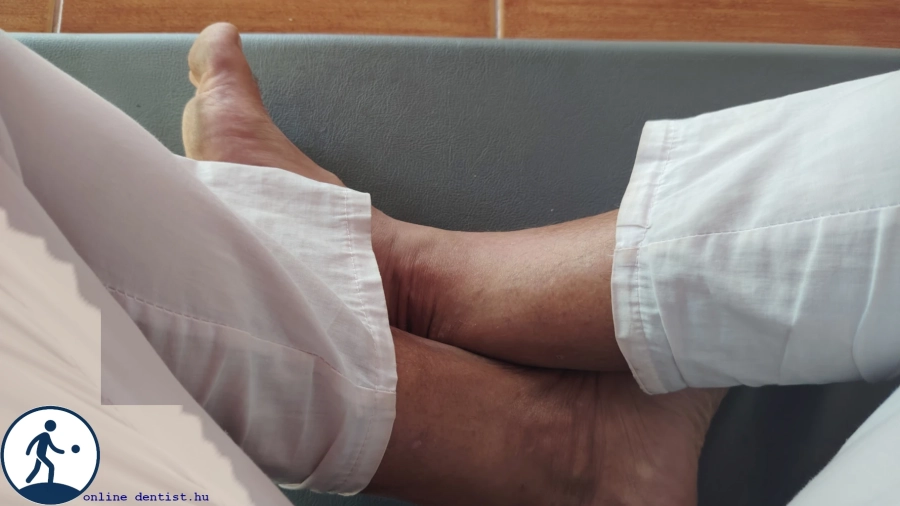
At that moment I took off my shoes, which – fortunately – I did not see for 10 days. Barefoot day and night. It felt very good. Another level of freedom.
A nice lady at the reception immediately welcomed me.
We discussed how long I wanted to stay, she checked my passport, I wrote my details in a big book. A really big book.
Then she showed me around the central part of the area. She showed me where I could buy white clothes. I got my pillow, blanket and mattress. She showed me which room was my room. I mean, not mine, but the one I would be in. There are 8 beds in total in this room, but at that time there were quite a few empty beds.
I chose one. And I stayed there the whole time. Those who came to the room kept dragging themselves. One bed was a little bit separate from the others, in a corner, half-covered by a closet. It was funny to see that as soon as someone left this bed, Someone else would move their stuff here. Then the next day that someone moved to a private room.
It kept going like this, someone would come to the room, sleep there for two nights, and then move. I didn’t want to move, the first place was perfect for me. On the side where I slept, there were three beds next to each other, and four across from us.
So I chose my only bed, threw off my sheets, changed into a white robe, and was ready for church life.
This robe is actually a pair of pajamas. Or, if you like, a hospital gown. A very loose, airy outfit.
It is not mandatory to wear it, I saw a few people wearing their own clothes, but the vast majority wear the “factory clothes”.
Personally, I really liked wearing this loose outfit day and night.
Minimalism on the Square
I didn’t really have to unpack my things in the room. It looks like I’ll only need a toothbrush, towel, underpants, and my paper tablet for 10 days.
I feel like I’m really close to the pinnacle of minimalism these days. I almost feel like I’m in the clouds of puritanism.
My bed is a simple plank, but I don’t sleep on the floor yet.
Apart from my own underwear, nothing of what I wear is mine. I wear a total of 3 items of clothing at all times, so 1/3 is my own, 2/3 I borrow. Not a bad ratio!
Toothbrush, toothpaste, towel, book, glasses. That’s all I use for 10 days.
It’s strange that there’s nothing to charge in the evenings. My watch only needs power every few days.
Silent
The next time I went to the reception, I had a small badge with the words “SILENT” on it.
I use it to signal to those around me that I don’t really want to talk. Many people wear badges like this here.
Some people take it so seriously that they even pantomime thank you, but others say a hello or a very short answer every now and then if necessary. In any case, everyone takes this signal seriously.
Offering lunch
My first official activity in the temple was offering lunch to the monks.
This is a Thai tradition, and it takes place in the following picture.
The monks kneel on a podium about 40 cm high, facing the interior of the hall. The abbot of the temple sits on the far left, this is his place. To his left, that is to our right, sit the other monks. There are two or three of them, it changes from day to day.
The women kneel in threes next to each other in a long line in front of the abbot. We men kneel in front of the podium, one by one, next to each other. And those of us who do not kneel in front of the podium (it is about 10 meters wide, so there are no places to kneel in front of it), sit next to each other on the steps, all the way to the tables.
The offering of food always begins with a few plates and a puree. The three women kneeling in front of them grab this at the same time, with six hands, with all the feminine energies of the three women, raise it above their heads, and then offer it to the abbot. He takes a plate and a ladle for himself and passes the rest on. The first man who thanks the abbot for this handover, then passes the plates to his companion kneeling to his right. The two men greet each other and the plate, and the one who takes it immediately passes it to the one on his right. If the plate belongs to a monk in the line, then that man offers it to him and not to the one next to him. The monk takes a plate and a ladle, then passes it on to the next man next to the previous man.
In this way, each monk finally receives a plate and a ladle. The last man kneeling at the end of the podium passes the things to the first man sitting. There, everything goes from hand to hand, until finally the last man in the line places it on the table.
In this way, the offering is actually made with the help of the feminine energies of all the women, and everything finally reaches the table through the hands of all the men. That is, everyone who is in the temple at a given moment participates in this ceremony.
The next element of the offering is rice prepared especially for the monks. Not only is it prepared separately, it is also brought here in a separate container. The abbot takes some of it for himself with the spoon that he already has. He lifts the rice from the plate above him into his own bowl of food, which he has also had since the first round. He takes a spoonful or two of rice for himself and passes the large bowl on.
Thus, each monk has the basis of his meal. The basis of every meal is rice.
Then come the various side dishes. Beans, potatoes, all kinds of vegetarian delicacies. From here, the monk decides for himself how much of what he takes and how much he passes on. Sometimes nothing is taken away, the bowl continues. If I remember correctly, it is the abbot’s prerogative to keep full bowls with him.
After the toppings, fruits, sweets, and other delicacies come. Each monk takes from the offered food according to his own habit. The rice and toppings go into the large bowl, and the fruits and sweets go onto the plate.
Every dish, every course is offered. So this ceremony takes quite a long time.
I’m not sure what the purpose of this tradition is, but it certainly develops patience and self-restraint. All the delicious food floats before my eyes and nose. Sometimes I wanted to take a bite. However, I only thought about it carefully, even as a joke.
It wasn’t offered to me. This is humility. It’s not the time yet. This is patience.
You can see it, you can smell it, but you can’t touch it, you can’t taste it. That’s self-restraint.
And if I offer it to the monk with a truly good heart, then it’s also respect.
After that, the abbot always gives a little speech. Half in English, half in Thai, he always thanks us for the offering, reminds us to be grateful to those who prepared it and made it possible, and then he offers us lunch.
It’s a table offering, a gift. I always remind myself of these things. We don’t pay for this food.
It’s good to remind myself that I’m especially grateful for this. I also remembered how many times we ate together last year with my parents and my younger brother.
The first meditation in the temple
The first session after lunch began with a walking meditation.
The title of the book published by the temple is “Walk to Become Understanding!”
So we don’t take walking meditation lightly. And we don’t rush it either. We covered the 2 km distance in 55 minutes. That’s about a third of the speed I usually walk.
The purpose of walking meditation is to practice presence. It became clear at first that if I walk at a snail’s pace for 45-55 minutes, it’s easier to pay attention.
Since I’ve walked a lot in my life – often quietly despite all the excellent hiking company – I’m not unfamiliar with concentrating while walking. I often use this technique. For example, to overcome difficult sections. It’s much more effective to count “left, left, left-right, left” than to think every 20 meters when it’s over.
But, even after walking thousands of kilometers, I had the opportunity to observe differently.
Since I was barefoot, I quickly discovered in my head the noise of my heel hitting the ground. For example, I started to concentrate on putting down the first part of my foot, then my heel.
It was an interesting game.
As well as actually feeling the connections and contacts of my foot with the ground. The ground is sometimes cold, sometimes warm. Smooth earth, rough concrete. Sharp rock, soft gravel, One moment the step is like this, the next it is different. It was an interesting experience to walk in that direction.
Resting during the day
On this first day, I didn’t look for how to be a useful member of the community. When there was no common program, I slept. I tried to settle the bill for the bus and the missed night.
And for some reason I didn’t worry about what would happen at night.
Chanting
The evening program included chanting.
This is an interesting thing. Seeing the chanting book, I felt very much like I did while reading the book on Krishna consciousness that I finished last week. The Sanskrit texts written there are just as readable and understandable as the Pali texts of the book I am holding in my hands now.
So the picture is interesting.
The way the monk sings it is also interesting. I have a feeling that there is no prescribed melody to the text, I just think the song comes in that form.
It is interesting how we sing it. After all, neither the words nor the melody mean anything to us.
As a lifeline, at the end of each paragraph there is an English summary of the paragraph.
If what has been written so far gives an interesting overall picture, then this is where we go into the experience, because it is a turning point when we sing this English text as well.
At first – for my part – I don’t see much point in trying to imitate the incomprehensible language of an unreadable text in an often tuneless voice.
But, I didn’t want to miss out, Then after a good half hour I noticed that there were no thoughts in my head. The chanting drove everything out.
Maybe that’s when they say that the session achieved its goal.
Dinner
According to the program, this activity doesn’t exist.
I didn’t write the title here as a joke, but more on that later.
Go to sleep
After showering and brushing my teeth, I read in my bed. By the way, the water is moderately cold, with a hint of lukewarm feeling.
The “SILENT” badge also helps in the room. And in the room, it is written by default that you should not make noise and stay quiet.
On my first night, five of us slept in the room. Everyone except one followed the house rules. I wasn’t the only one who didn’t!
I put down my book at 9:52 PM and the day was over.
This hasn’t happened to me in a thousand years.
Buy me a coffee?

If you enjoyed this story, you can buy me a coffee. You don’t have to – but it means a lot and I always turn it into a new adventure.
Buy a coffee for Steve
 Linktree
 Short introduction