
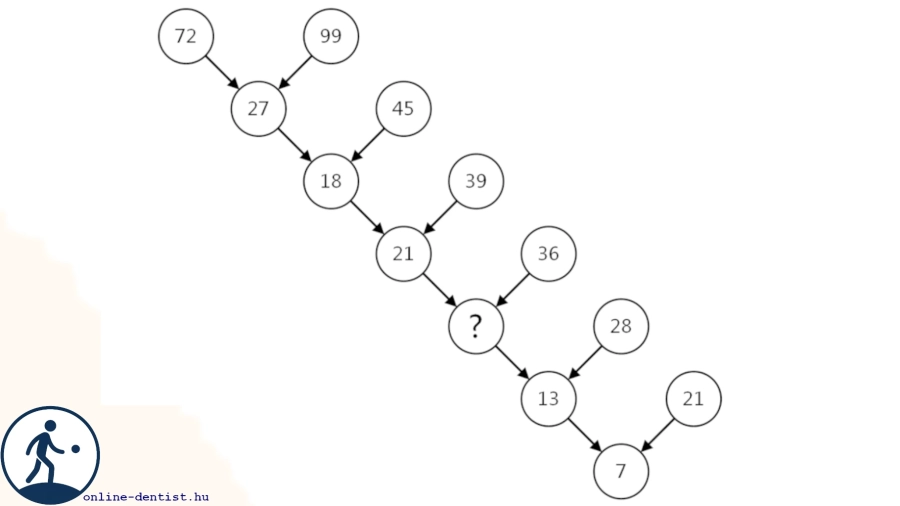
I came across this puzzle a few weeks ago.
I love puzzles like this, so I set to work on it right away.
If you enjoy puzzles like this, I suggest trying to solve it first before reading the rest of this post.
I Got It Wrong
Puzzles like this often appear before me with the exact same kind of hook this one had. Precisely like this:
Can you solve it?
Update: If you got 15 on your first try, give it another go!
This is a classic case of a “challenge thrown down.” Someone who already knows the answer is essentially declaring that I won’t be able to figure it out. Challenge accepted.
It was very simple to arrive at the number replacing the question mark: 15.
To be honest, I didn’t quite understand why this result was incorrect. After all, it seemed right! So, I had to look up the solution.
It wasn’t what I (and others) had suspected. In other words, the method isn’t simply subtracting the two adjacent numbers (subtracting the smaller from the larger) to get the number beneath them. Because—and I hadn’t noticed this either—that doesn’t hold true for 21 and 13; if it did, the number below them would have to be 8, not 7. But I missed that detail when I first solved the problem.
It is an elegant puzzle. A beautifully constructed trap. I wasn’t the one who identified it as a trap; Nobuyuki “Nob” Yoshigahara, a renowned Japanese puzzle master, created it. He designed this puzzle late in his career. Perhaps he envisioned it as a masterpiece?
Once I had deciphered the initial numbers, I made quick progress toward the solution. Yet, the creator’s question—the one used to set the trap—might not have actually been “which number goes in the ninth circle?” Perhaps he asked instead, “When will you decide that you already understand the rule?”
The solution to the puzzle
The solution that makes the entire puzzle work is as follows: Add up all the digits of the two upper nodes. This gives you the number located beneath them.
Calculating this way, the number that actually goes into the 9th circle isn’t 15, but 12.
And from there, you can proceed further.
It is indeed an elegant puzzle.
But that is not what I wanted to write about.
Rules
I started thinking about this problem because, at first, I didn’t realize that 15 wasn’t the correct answer—even though I already had the rule that yields 12 (the actual correct result).
With the help of AI, I devised a new method: “Subtract the smaller number from the larger one. If the result is 8, subtract another 1. Otherwise, leave it unchanged.”
Using this rule, 15 becomes the correct result.
Then I took it a step further and found another rule: “Take the difference between the two numbers. If the difference is 15, subtract 2; if it is a single-digit number, subtract 1; otherwise, leave it unchanged.”
With this rule, the correct result is 13.
What do rules actually mean?
A few thoughts crossed my mind. Simpler rules are better. A rule should be consistent. It shouldn’t have special exceptions. One must discover the rule the author originally intended. The most elegant rule is the correct one.
Where have we heard these ideas before?
If I recall correctly, that is the sort of thing I was taught everywhere. Here is the rule. It explains everything. Except for this one case. Oops. So, we modify the rule. And suddenly, it works again.
This reminded me that this line of reasoning is very similar to the one I began developing for my own philosophical system.
We strive to explain the systems we live in. To do this, we formulate rules. Then, we experience these systems in accordance with those rules. There is no problem with this—until tension arises between the system’s actual functioning and our experience of it (specifically, the individual’s experience).
Let me put it more clearly. Take the teachings of the Christian church as an example. That is a system of rules. The system it governs—the functioning reality—is life itself. Everyday life. As long as someone lives their Christian life by fully complying with the church’s precepts without experiencing any tension in their daily routine, then—perhaps—there is no problem. But when they begin to have experiences for which—in their view—the church offers no answer, the result is usually dissatisfaction.
I cannot change the system (in this case, the everyday life that surrounds me). The system of rules (in this example, the Christian church) offers no solution to the tension. Moreover, in this instance, the system of rules itself cannot be modified. The outcome of this situation may not necessarily be positive.
I did not intend to offend anyone with this example. I could just as well have cited systems governing romantic relationships, the financial world, or even child-rearing.
The key point here, I believe, is that systems are generally very complex, whereas the systems that describe them are invariably simpler.
Some systems can afford to constantly change their rules; others cannot.
What does this have to do with life?
Rules describing systems are necessary. Yet, they are not always infallible. As this number puzzle demonstrates, at least three different types of rules can be devised to reach a solution.
Who, then, could say that rules established by others are necessarily suitable for ensuring a stress-free life for everyone?
If I were to replace the word “stress-free” with “happy,” it would likely become immediately clear why I wrote about this puzzle.
Let me state, for the first time in my life, an idea that I intend to substantiate in my future work.
Each individual is responsible for either accepting the set of rules necessary for their own happiness or working to shape them.
Buy me a coffee?

If you enjoyed this story, you can buy me a coffee. You don’t have to – but it means a lot and I always turn it into a new adventure.
Buy a coffee for Steve
 Linktree
 Short introduction