
Could music be my horse?
I have never whispered to horses. Just as I have never danced with wolves. Yet, music often tames a wild, rampaging horse, transforming it into a true magical steed—a faithful companion held within my embrace.
There are steeds that return time and again.
One of them is That Sunday in Temesvár.
A Bit of History
On February 24 and 25, 1990—barely more than two months after the fall of the Ceaușescu regime—the Hungarian rock band Bikini played two sold-out concerts at the Olympic Hall in Timișoara. February 25 happened to fall on a Sunday.
The event was one of the first major, unrestricted rock concerts in the region following the revolution. The band performed two songs composed specifically for the occasion, one of which was “Timișoara Sunday” (That Sunday in Temesvár).
In truth, there is some confusion among various sources regarding the circumstances of the song’s creation. It is generally understood that the track evokes the events of 1989 in Timișoara—the beginning of the Romanian Revolution. However, some sources suggest that Zsolt Daczi, the song’s composer, originally wrote it in memory of his sister, Barbara, who passed away at a young age. It later became an anthem commemorating the revolution, at which point it was given the title “Timișoara Sunday.” I have also come across accounts suggesting that the song was inspired by the poem “Behind God’s Back” (Isten háta mögött) by Sándor Kányádi.
The Horse Whisperer
Even a historical overview reveals that the origins of this steed are unknown—or, at the very least, shrouded in the mists of obscurity. And yet, it came into existence only 36 years ago.
So, picture a horse. Wild, noble, and governed by its own nature. Free. Strong and proud.
Then, there is the “horse whisperer”—someone who establishes a connection with the animal by understanding its behavior, reading its body language, exercising patience, and building trust. The “whispering” is not to be taken literally; it is not some secret language or supernatural ability. Rather, it is about learning to perceive the animal’s signals—its posture, the movement of its ears, its gaze, its breathing, and the tension in its muscles—and then adjusting one’s own behavior in response.
And there I am!
The horse whisperer does exactly the same thing with a horse that I do with music. I perceive the signals within the music: its tempo, rhythm, chord changes, and dynamics; its orchestration and pauses; its structure and progression; its solos, unisons, harmonies, and a thousand other qualities. And then, either we find a connection—or we don’t.
I cannot recall when we first met. But I do remember trying to break in this horse. I am a guitarist. Of course I tried to play this iconic song. It got the better of me. It kept throwing me off. I don’t think it was because we weren’t a good match; it was simply because there was something I needed to feel.
I run alongside this horse—I don’t ride it. After all, we are both free.
Let’s Run Together!
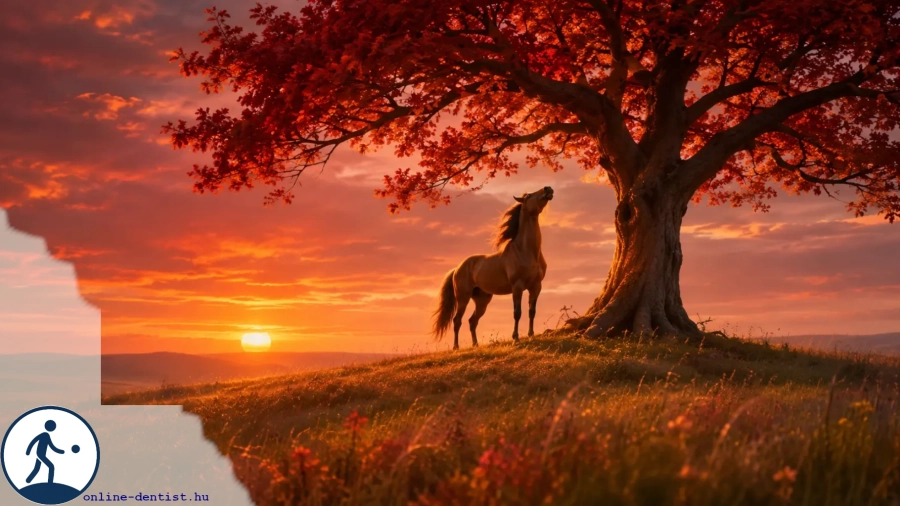
A single tree stands in the middle of an endless field, painted red by the light of the setting sun. A gentle slope leads up to it. This is where we meet today.
He stands beneath the tree, his head raised toward the sky. His nostrils are flared; he catches my scent. We both know who the other is. In his eyes, there is the thrill of anticipation—the same excitement that would be reflected in my own eyes, could I see them.
I approach him slowly. Every step is cautious—not out of fear, but simply because this is the way it must be. We will run later; for now, we savor the joy of being reunited. I have brought him nothing—I would not wish to wound his pride. I hold out my open palm, facing upward. It is just me; I have come with a naked heart.
First, I hear the sound of the rising wind—and then, him. For a moment, he sings—slowly, very slowly. His voice becomes one with the breeze drifting across the field. His song is strong, proud—a dignified greeting. He does not lower his head, not even for an instant. I step before him; we look into each other’s eyes, and I touch his neck. My palm rests there. I feel his sounds, rather than merely hearing them.
There is a sorrow in these notes—long, drawn-out, vibrating melodies that build toward a long, powerful cry. It is as if we were exhaling, only to take a deep, refreshing breath afterward. We need it.
We begin with a slow run. We skip the introductory walk. Our strides are heavy; our feet strike the ground with force. This run is not about speed. We are not racing. We are savoring the moments—the moments we share. I run with a flushed face and a smile; he tosses his mane and lets out a whinny. I admire his head, held high. I look into his eyes—what I see there, I might call a smile.
He keeps an eye on me. He doesn’t speed up; he knows I couldn’t keep pace. He channels his energy by circling me a few times, kicking up the dust. One might think he’s acting wild, but there is no aggression—only raw power. And I have that power, too. We run to share this strength—with the world, and a little bit with each other. Joy is the very purpose of this run.
The melodies are familiar, yet every phrase is different. I know his ways; he loves to improvise on the tune. No two are ever the same. It is just like the wind that surrounds us, ruffling the grass—free, ever-changing, powerful, and fragrant.
After one final burst of effort, we begin to slow down. Eventually, we come to a halt.
A long, sustained sound serves as our farewell. Nothing more is needed. There are no words, and no final touch is required. We only need to look into each other’s eyes.
Neither of us is going back to the tree. She goes left; I go right.
Next time, we’ll meet where the Sun rises. Or somewhere else. There is no plan.
On the Way Home
Heading home, still catching my breath, I reflect on what we have just relived—and what we relive time and again. Alongside the emotions, there is always reason; on the way home, it is reason that tends to take the lead.
We don’t always meet in the same place. Consequently, every encounter carries a different emotion and a different meaning.
The sound of the horse resonates simultaneously in my gut and in my heart. More often than not, it also clouds my vision.
The emotions I carry within me are surely the root cause of why my eyes grow misty in any given moment. The song holds deep emotions—but the specific, profound feeling it connects to at any particular time is merely a reflection of my current state. The song’s power for me doesn’t stem solely from thoughts of Barbara—Daczi’s sister—nor from my own personal sorrows. Sometimes it strikes a chord because Daczi is no longer with us; other times, because I find myself picturing Timișoara on that afternoon; or perhaps because I am grappling with a problem of my own. At times, it carries no specific meaning in my mind at all—I simply feel the pain itself.
After this shared journey, my soul feels neither lighter nor heavier; its weight remains unchanged. For me, this song is not a form of “relief.” I don’t listen to it just to have a good cry and then move on; it doesn’t cross my path as an invitation to self-pity. It is like a bathtub filled with sorrow. I submerge myself in it. I bathe in the sorrow. I allow my soul to rest within the pain. Then I continue on my way.
I do not immerse myself in this tub to wash anything away. The act of immersion itself is the experience.
Sorrow is just as much a part of my happiness as joy is. Simply put, because my happiness stems from experiencing the fullness of life—and so, sorrow has its place within it, too.
Buy me a coffee?

If you enjoyed this story, you can buy me a coffee. You don’t have to – but it means a lot and I always turn it into a new adventure.
Buy a coffee for Steve
 Linktree
 Short introduction