
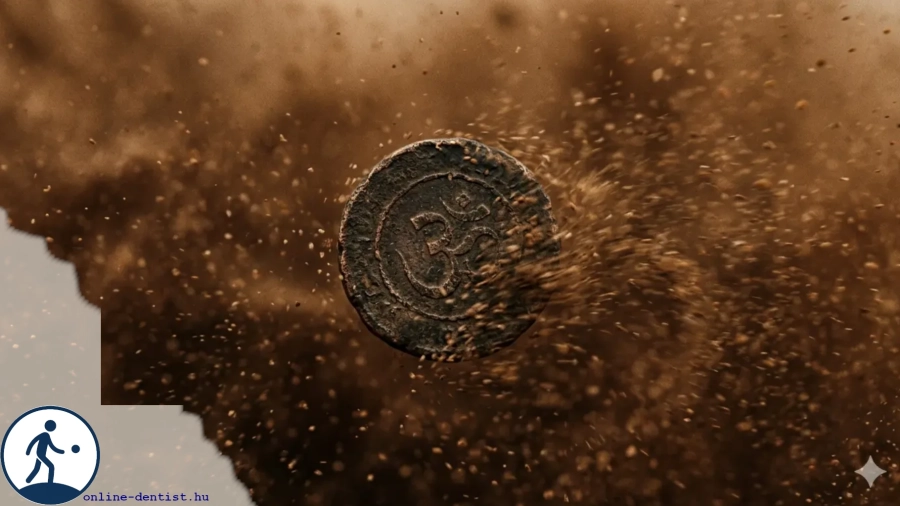
See, my friends, with your eyes, what we are: behold, we are dust and ashes.
“Funeral speech and supplication.” 1192. The earliest Latin-script, entirely Hungarian-language text supplement.
Perhaps since the emphasis on thinking has been on what we are, people have been interested in it. Obviously since 1192.
Somehow, the image that we are dust, ashes, sand is close to me.
With the support of two songs, I look into the dust cloud.
Music generated by AI
Music plays a decisive role in my life.
Exactly the kind of music that is performed on real instruments. Even though I like it, I have reservations about purely computer-generated music.
In light of this, it was surprising to me how much I enjoy music created by AI, or rather, music reinterpreted by AI. For example, AI transforms a well-known Abba hit into a metal anthem. Or creates a pop cover of an industrial metal song that looks like a hit.
I think my enthusiasm is not so surprising after all. AI, as a pattern analysis software, excels at this kind of work. By analyzing patterns, it can interpret why something works, so it can easily create something new based on a well-functioning pattern.
For me, this method works incredibly well. It creates something new, bursting with fresh energy, from a strong, meaningful song. Something familiar, yet completely different. Of course, it doesn’t always work out perfectly, but let the software have the right to sometimes mess around.
I created a YouTube playlist where I saved songs reinterpreted by AI that I find enjoyable. You can listen to them here.
I would have a hard time choosing a favorite from this list, and that’s not what I intended this post to do.
I’ll pick one out now, because not only was the power of reinterpretation important when discovering this song, but also its lyrics.
Dust in the Wind
I’m talking about the song Dust in the Wind, written by the world-famous band Kansas in 1977.
I first heard this song about 25-27 years ago. The iconic guitar playing first caught my attention, and then of course the lyrics had a big impact on me.
I recommend that you listen to the original version now. Follow the lyrics if you feel like it. I also made a Hungarian translation of the English text for the sake of this post.
[steve_audio yt=”tH2w6Oxx0kQ” title=”Dast in the Wind (Kansas)”]I close my eyes
Only for a moment, and the moment’s gone
All my dreams
Pass before my eyes, a curiosity
Dust in the wind
All they are is dust in the wind
Same old song
Just a drop of water in an endless sea
All we do
Crumbles to the ground, though we refuse to see
Dust in the wind
All we are is dust in the wind
Now don’t hang on
Nothing lasts forever but the earth and sky
It slips away
And all your money won’t another minute buy
Dust in the wind
All we are is dust in the wind
(All we are is dust in the wind)
Dust in the wind
(Everything is dust in the wind)
Everything is dust in the wind
(In the wind)
Lehunyom a szemem
Csak egy pillanatra, és pillanat már el is tűnt.
Minden álmom
Megfoghatatlanul suhan el a szemeim előtt
Por a szélben
Mind csak por a szélben
Ugyanaz a régi dal
Csak egy csepp víz a végtelen tengerben
Minden, amit teszünk
Porrá hullik, de ezt nem akarjuk látni
Por a szélben
Mind csak por a szélben
Ne kapaszkodj hát
Semmi sem tart örökké, csak a föld és az ég
Minden elúszik
És minden pénzeddel sem vehetsz egy újabb percet
Por a szélben
Mind por vagyunk a szélben
(Mind por vagyunk a szélben)
Por a szélben
(Minden por a szélben)
Minden por a szélben
(A szélben)
And now maybe listen to the reinterpreted version.
[steve_audio yt=”XtYyahxoBIA” title=”Dast in the Wind (AI, Kansas)”]My opinion is that the reinterpreted version contains much more energy than the original. Along with the fact that the original is a masterpiece. Maybe that’s why the new version has such an impact on me.
Sand in the Wind
When I was thinking about this post, about what I wanted to say, it occurred to me that we have our own Hungarian song on the subject. It’s a timeless hit by Balázs Fecó and Korál from 1981. How interesting that there is only a four-year difference between the birth of the two songs.
I’ll follow the previous order. I’ll show you the original version, the lyrics in both languages, and the arrangement.
[steve_audio yt=”PihamsrWafA” title=”Homok a szélben (Korál)”]Ne kérd, hogy ígérjem meg azt, amit nem tudok,
Szeretlek és melletted vagyok.
De tudod jól, hogy eljön majd a nap,
És nem lesz semmi, ami majd visszatart,
Mert sehol sem tudtam megnyugodni még,
Ha nem lennék szabad élni sem tudnék.
Homok a szélben, azt mondod, az vagyok.
Homok a szélben, lehet, hogy az vagyok.
Homok a szélben, tudom, hogy az vagyok.
Homok a szélben, megváltozni nem tudok.
Meder nélküli folyó leszek nélküled,
És meglehet, hogy sokszor tévedek,
És minden reggel máshol ér talán,
És senki nem fog emlékezni rám,
És nem tudom, hogy mi történhet még,
De ha nem lennék szabad élni sem tudnék.
Homok a szélben, azt mondod, az vagyok.
Homok a szélben, lehet, hogy az vagyok.
Homok a szélben, tudom, hogy az vagyok.
Homok a szélben, megváltozni nem tudok.
Don’t ask me to promise what I cannot keep,
I love you, and I’m here with you.
But you know well the day will come
When nothing’s left to hold me back,
’Cause I have never found my peace anywhere,
And without my freedom, I couldn’t even live.
Sand in the wind, you say that’s what I am.
Sand in the wind, maybe that’s what I am.
Sand in the wind, I know that’s what I am.
Sand in the wind, I cannot change who I am.
I’d be a river with no bed without you,
And maybe I’d go wrong a thousand times,
And every morning might find me somewhere new,
And no one there would remember me,
And I don’t know what else may come my way,
But without my freedom, I couldn’t even live.
Sand in the wind, you say that’s what I am.
Sand in the wind, maybe that’s what I am.
Sand in the wind, I know that’s what I am.
Sand in the wind, I cannot change who I am.
Of course, I have my own opinion on the two songs in this case as well. For me, the AI-generated version is clearly worse than the original.
Here’s an example of how not all AI is gold.
A little more music
Although the two songs were written almost at the same time and their lyrics are similar, I think that musically they approach the subject from a different perspective. They are emotionally close, but musically they are not original/copy, they are more like “inspired relatives” in my eyes.
The song Kansas means “thinking about life in silence”, while Korál means “feeling and speaking the silence” approach to me. The former is meditative, quieter, more philosophical, while the latter is a more emotional, dynamic, dramatic formulation of the subject.
That’s all I think is important about music now, whether I’m thinking of the original or the regenerated versions. After all, the musical experience is only part of what I have to say.
In relation to these two songs – similar to the music – the message expressed in words is also very important to me.
Ashes, dust or sand?
The question is poetic. Of course, the word is irrelevant, just as the choice was made just for the sake of the joke.
Both songs are about passing away.
Apparently.
Just as poetic freedom allows the work to convey the author’s thoughts as the author wants, the recipient of the work also has the right to their own interpretation.
For me, the song Kansas is about the fact and acceptance of human transience. If I change a few words (cling to/to cling to, elusive/illusion) it could even be a Buddhist philosophical song. So it’s simply a song with a Buddhist atmosphere.
The term doesn’t fit it because, in addition to Buddhist resonances, it “lacks” an important element of Buddhism, the path, or in other words, the solution.
The song Korál, on the other hand, is about the freedom of the self. Here, the sand that circulates in the wind is a symbol of freedom. Moreover, the song is strongly inclined to show the solution. And although this is what separates the previous song from Buddhism in my opinion, this song does not fit into the philosophical system either. After all, here the ego takes the focus away from it.
The difference between the two songs is palpable. Musically and lyrically.
Two sides of the coin appear.
I then put the coin on its edge. The edge, which is there, is the eternal third side, but we don’t talk about it too much.
The moment
I was not captivated by the two pages presented above in either text. I believe it is true that we are only dust, just as it is important that we can only dance freedom with the lightness of sand blown by the wind in the ball called life.
Yet, something else emerges from the cloud of dust.
I love that the English-language song resonates with me like this:
“I close my eyes for just a moment, and (that) moment is no more.
My life has become very different since I have been alive, I constantly experience the power of the moment. And now I am not talking about the role of presence that is often mentioned. Experiencing the moment does not only mean that I now stand in front of the things around me with natural simplicity and enjoy happy moments.
The edge of the coin for me now is that the power of the moment lies in the fact that, along with being happy about it, I immediately let it go. The simplicity of passing away, letting go, saying goodbye, which in Buddhist terminology I could call the reduction of attachment, has appeared in me.
Joy that is for the moment, without sorrow that that moment is no more. For me, this is one of the definitions of freedom.
To testify to the idea in another way, I must say that I am not free because I traveled to the other side of the world I spend my life, but I have learned to travel from one moment to the next.
And perhaps this is my first syllogism.
Floating from moment to moment is my true traveling. Traveling is happiness for me. I am happy.
Buy me a coffee?

If you enjoyed this story, you can buy me a coffee. You don’t have to – but it means a lot and I always turn it into a new adventure.
Buy a coffee for Steve
 Linktree
 Short introduction