
Summary
The Gibbon Experience was designed to inspire you, foster your energies and remind you to change perspectives. The Gibbon Experience project is meant to be an allegory of our reconciliation with the rainforest.
When I asked the AI what attractions there were in or around this town, it drew my attention to a few things in its response.
One of them was the Gibbon Experience.
A gibbon experience?
Gibbon Experience. This is the world-famous program in the area. Jungle canopy zipline, sleeping in tree houses, in the Bokeo Nature Reserve, a chance to meet wild gibbons. Many travelers come here just for this.
I think these sentences represent the experience of love at first sight for me.
By the time this post is published, I will be living in the jungle.
When I get home tomorrow, I will start writing the next post about my experiences.
But in the meantime, I will introduce this extraordinary program.
What awaits me?
We built the world’s highest treehouses so you can glide through the forest canopy by day and wake up to the symphony of the jungle by morning.
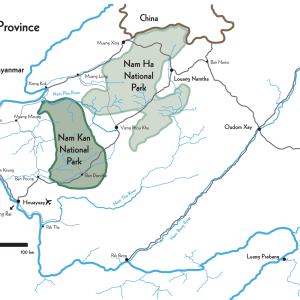
Your interest and presence in the forest has raised awareness for the need for its conservation, and made the creation of the Nam Kan National park possible.
Today, hundreds of people from local communities earn their livelihoods through this conservation project. By visiting the treetops of the Gibbon Experience, you are not only protecting the National Park, but also supporting an entire community dedicated to preserving its future.
In other words, they describe this program as a tourism-based nature conservation enterprise. For example, on the project website, they very clearly show how the participation fee paid by visitors contributes to the protection of the forest and the livelihood of the local community.
The program started 30 years ago to protect the forest and grew into a national park 14 years ago.
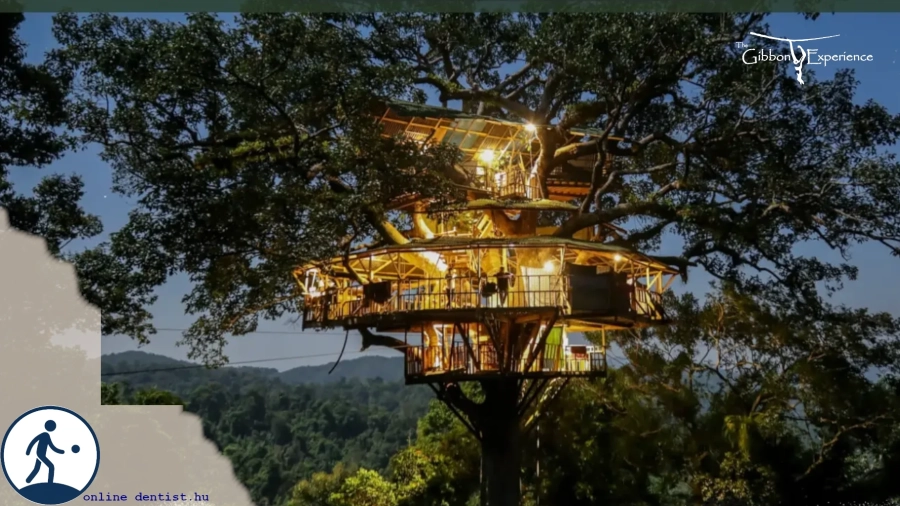
We build tree houses as high as we safely can so that your room directly overlooks the forest canopy. Different designs are possible; we have worked on three types of tree houses :
- Tree houses suspended on rope wires
- Tree houses set on wooden consoles
- Geodesic polyhedron laid in the fork
The choice of construction type depends on the tree structure, shape and situation. Each construction is a new challenge because trees are just as different from one another as people.
In 2003, we invented gravity access to the canopy. This low-tech, safe and easy way to ascend the tree tops taking advantage of the terrain slope. All our tree houses are accessible this way.
At The Gibbon Experience, we also use ziplines to fly from hill to hill. This enables trekkers to go deeper into the forest while reducing up-and-down walks.
For some of our itineraries, what would have been an 8-hour walk was reduced to 2 hours thanks to the ziplines. The Gibbon Experience’s itineraries currently feature a total of 15 km of ziplines, some of them as long as 600 meters.
They offer four types of programs to visitors, I chose the Classic tour.
The Classic (3 days, 2 nights) is the best option to see or hear gibbons. It is also our easiest trek, with one to two hours of reasonably hilly access walk. It is therefore recommended for trekkers from 8 to 65 years old and in good physical condition.
You will choose how you want to spend your time, there is no strict schedule and guides will accompany you to your treehouse and around for trekking and ziplining. This option usually enables gibbon encounters when they are in the area.
Your group of up to eight people depart Huaysai office soon after 8 am for three days and two nights in treehouses scattered within the Nam Kan National Park. The return time on the last day is between 3 and 4 pm.
In the green season (mostly from July to September) because of the rain, visitors should be in better physical condition as trekking is more challenging on muddy trails. Parts of some treehouses may also get occasionally wet. Finally, the time actually spent in the canopy will be shorter than in the dry season as a result of longer walks.
Under exceptional heavy rain, the walk to the treehouse can take up to five hours when the 4×4 vehicle is not able to reach the end of the track. This has only occurred a handful of times over the years.
However, the rainy season is the best season to explore and observe biodiversity with all its colors and sounds and to discover amazing flora and fauna species mostly active during that time. Those who choose this period are always rewarded.
Please note that during the months of August and September, tours may be subject to cancellation due to poor road conditions. Additionally, the Classic tours are paused from August 14 to September 15.
What to bring : head torch (mandatory), walking shoes, mosquito repellent, binoculars, raincoat (rainy season).
Finally, one more thing:
With my application, I received a very serious compilation of the wildlife of the national park, which we will use in the forest to identify animals.
It is worth browsing through, so I am making it available HERE.
This is an educational post now.
But I wanted to show you what an amazing project I’m involved in so much that I couldn’t leave it out.
I will report back with my own experiences soon!Buy me a coffee?

If you enjoyed this story, you can buy me a coffee. You don’t have to – but it means a lot and I always turn it into a new adventure.
Buy a coffee for Steve
 Linktree
 Short introduction