

I received an email on Sunday morning.
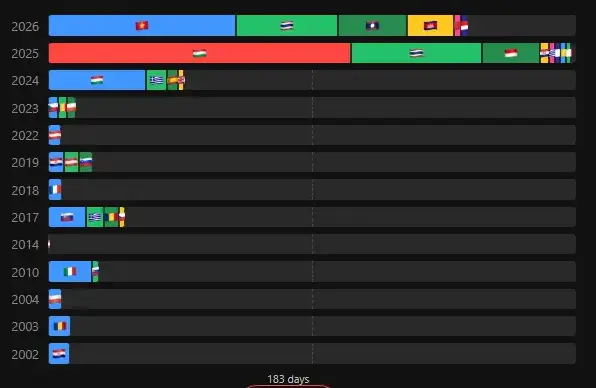
You risk becoming a tax resident in 78 days if you stay in  Thailand because you’ve been there for 105 days in the last 12 months. Staying somewhere for 183 days can automatically make you a legal/tax resident in many places. See residence calendar.
What’s up?
nomads.com
Let’s start at the beginning.
Exactly 22 months ago, I paid a one-time entry fee of 100 USD to join nomads.com. I even wrote about this back then in my post titled “Starting specific tasks.” Through this site, I gain access to valuable information regarding various countries, cities, and the general conditions for living as a digital nomad.
Visitors to the site (who aren’t members) can also learn quite a bit about my travels—provided, of course, that I’ve entered the relevant details into the system myself. As for whether I keep that data up to date? Well, naturally, I do. So, by clicking the link above, you can view my travel history within that system as well.
Among other things, I also use a feature from this platform to display my travels on a rotatable globe right here on my own website. You can see this under the menu item “My Maps / My globe.”
It was through this system that I received the notification mentioned above.
Along with it, the system presented a summary in the email—something I hadn’t even been aware of until now: my “residence calendar.” Since this is accessible only to me, I’ll share the image that greeted me when I clicked the link.
Interestingly, this site also displays values for “Radiation exposure from flying” and “CO2 emissions from flying” in relation to my flights. Wow!
So, from the letter, I learned that there was a possibility of an automatic status change. Tax! That word—with its mere three letters—is more frightening than a monkey in the Monkey Forest of Denpasar about to pounce on me. I took this “threat” seriously, which is why this piece was written.
What is a tax resident?
The term means exactly this: In practice, acquiring Thai tax residency would mean that Thailand could gain the right to tax certain portions of my foreign income—not just the income I derive from within Thailand. This is particularly relevant given my Hungarian sole proprietorship.
Foreign income! LOL. Thai income. Hilarious. Any form of taxation—including the possibility of Thailand levying taxes on me—requires the filing of a tax return. So, even if Thailand were to claim a right to collect taxes from me (as well!) based on the number of days I spend there, they would first require me to submit a tax return. They would be quite surprised to see nothing but zeros in every single line of that return. I am always happy to pay the tax assessed on a figure of zero.
On the flip side, there is a double taxation avoidance agreement between Hungary and Thailand. Its purpose is to coordinate the taxing rights of the two states and, where necessary, address instances of double taxation.
Do the numbers hold up?
In addition to the nomads.com system, I also keep track of my travel details in an Excel spreadsheet. Sorry, but I can’t just keep it all in my head! In this spreadsheet, each row represents a city (and country) where I’ve lived. Alongside the start and end dates, I’ve also—retroactively—begun recording how many different beds I slept in at each location. Later, I added a breakdown of how many nights were spent in private accommodation versus shared (dormitory-style) lodging. This spreadsheet allows me to cite precise figures—for instance, in my blog posts.
It also comes in handy for verifying the message I just received.
As it turns out—unsurprisingly—nomads.com’s calculations are accurate. I did indeed spend 105 days in Thailand over the past year. My total time spent in Thailand breaks down as follows: August 22, 2025 – November 21, 2025 (92 days) and January 5, 2026 – March 15, 2026 (70 days), for a total of 162 days. Looking specifically at the last 12 months, that adds up to 105 days: October 18, 2025 – November 21, 2025 (35 days) plus January 5, 2026 – March 15, 2026 (70 days).
However, there is an important nuance to the calculation.
Nomads.com uses a rolling 12-month time window. So, it calculates based on the “past year,” disregarding the fact that the count reset on January 1, 2026. Consequently, for tax purposes, I have only spent 70 days in Thailand so far this year. This means I don’t have 78 days left until I reach the threshold for tax residency; rather, I have 180 days minus 70 days—leaving 110 days.
I am currently visiting Thailand under the 30-day visa-exemption policy that has been in effect since September 15th. I plan to stay for a maximum of 30 days, though that could change—I might end up staying longer.
Assuming I stay for the full 30 days, my total for this year will be 70 + 30 = 100 days. Even if I am still in Thailand on December 31st, the maximum amount of time I could possibly spend there for the remainder of the year is 145 days.
Therefore, I do not need to file a tax return. I won’t have to present a bunch of zeros to the Thai tax authorities. What a relief!
The numbers matter
However, there is one thing I had to learn on Sunday morning—an important aspect of the digital nomad lifestyle.
If I plan to live in a given country for around five months, I absolutely must look into the issue of tax residency.
Does that country use a rolling calculation method or not? And is there a double taxation avoidance agreement in place with Hungary? If the question of taxation arises, the tax rate will naturally need to be examined as well.
For the time being, this isn’t a pressing issue, as I typically move on from any given country within a maximum of three months. However, this current pattern may not necessarily remain permanent.
These aren’t exactly the topics I had planned to start my Sunday morning with. That said, I am grateful that this subject matter has come my way.
I can add another notch to my belt as an experienced digital nomad—and I’ve gained the opportunity to write a new post. Perhaps this account will prove useful to other digital nomads as well.
Buy me a coffee?

If you enjoyed this story, you can buy me a coffee. You don’t have to – but it means a lot and I always turn it into a new adventure.
Buy a coffee for Steve
 Linktree
 Short introduction