
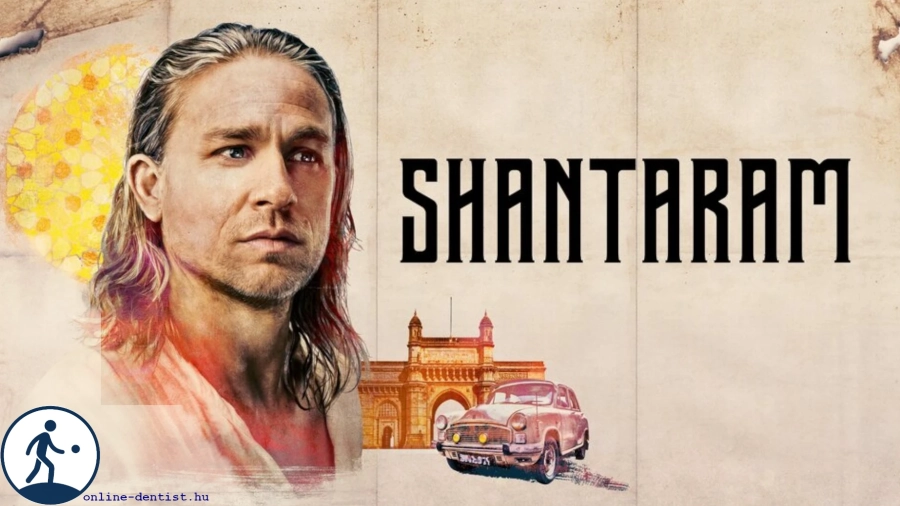
Shantaram is a book.
Shantaram is a term. “Man of peace,” or, more precisely, “man of God’s peace.”
The book is perhaps about me (too).
At least, that is what I hope.
The Story
Someone recommended this book to me back in May, while I was on a journey. I only began reading the two-volume novel early last week. I haven’t regretted it. And I’ve come to understand why it was recommended to me.
We were talking about life at the time, which is how I heard about the book. Now, as I write this post, I’ve discovered that it was also adapted into a television series—though the show was cancelled after its first season. Furthermore, based on the descriptions, it seems to lack the very element that made the book so compelling to me.
So, let’s stick to the book. In short, the story goes like this: Lin Ford, an escaped convict, flees to the bustling streets of 1980s Bombay to vanish from the world’s sight. Working as a doctor for the city’s poor and destitute, Lin finds unexpected love, genuine connection, and courage along his long journey toward redemption.
I am not a convict. I didn’t flee (or, at least, only partially). I didn’t set out to disappear—though, in a way, I managed to do just that. Nor am I on a path to redemption. Yet, as I began reading, the story resonated with me in an uplifting way.
I started to wonder why I feel such a strong personal connection to someone else’s story.
Why Do I Feel Such a Personal Connection to This Story?
I have an inkling—one that I believe goes deeper than the mere fact that we both set off for Asia, left behind a former life, and began something entirely new within a foreign culture.
I am not simply reading Lin’s story. I am reading the story of someone grappling with the same fundamental human questions that I have been exploring in my own writing over the past two years or so.
How can I become the person I want to be? Where is my home? What is freedom? To what extent can I trust others? Why do certain things happen to me? What does it mean to be good? How can I live with my past?
And perhaps most importantly: how can one set off into the unknown—not by losing oneself, but by finding oneself?
There are a few particularly strong parallels that I believe may explain this feeling of mine.
The Peculiar Duality of Escape and Arrival
Lin flees Australia. He doesn’t simply want a new life; he is also running from his past. In India, an opportunity arises for him to reinvent himself. I am not an escaped convict—and this is not merely a humorous distinction. In Lin’s story, freedom begins, in part, as a forced escape. In my story, it is a conscious choice.
Yet, my own departure was also preceded by significant personal upheavals. Certain parts of my old world could no longer provide what I needed. In my piece titled “The Decision,” I wrote about how the idea of escape had crossed my mind before. But then, something shifted.
I didn’t just want to leave Hungary. In time, I came to realize that I wasn’t running away from something, but rather moving toward something.
For Lin, Bombay is a place where the weight of his former identity seemingly dissolves. For me, Asia became a space where—alongside my previous roles—I could inhabit an entirely different way of life.
The common thread between us is not the act of leaving, but the discovery that our past does not necessarily dictate who we might become tomorrow.
This strongly resonates with a working title for one of the books I am currently developing: It Is Not Where I Looked for It. I set out into the world to find my way home. This could even be a personal formulation of one of the central ideas of Shantaram.
Home, Not as a Geographical Location
Perhaps this is one of the strongest parallels.
In my piece titled “Home, sweet home,” I recalled that by the age of 49, I had lived in 21 different places. I also reflected on how long I had searched for a place I could truly call home. Then, in a post titled “My roots,” an important realization emerged: “You’re not rootless at all, Soma! You just hadn’t noticed until now that your roots are within you.”
Now, let’s consider Lin. He has lost the life he once belonged to. He arrives in Bombay as a stranger and gradually forms unique bonds with people whose cultures, financial circumstances, and life stories are vastly different from his own. Through his friendship with Prabaker, he gains something that could never be found in any guidebook: the possibility of being embraced and accepted.
And here lies a very interesting distinction between us. I came to the conclusion that my roots lie within myself. Lin’s story adds another dimension: the sense of “being at home” can also emerge through the connections we forge with others. The two are not mutually exclusive.
Over the past year, I, too, have come into contact with a great many strangers. Countless times, I have experienced kindness—kindness I neither asked for nor expected—which, in many instances, did not even require a shared language. Perhaps Shantaram resonates with me because, in Lin’s story, I see something at play that I have experienced many times in my own life: that foreignness and a sense of being at home are not necessarily opposites.
Judging People and Discovering Humanity
I have never had an issue with humanity—with cultivating it, or with recognizing and accepting it.
Judging people, however, has been a different story. I typically tried to squeeze everyone into the “good” category—or at least imagined them there. As a result, I was often and painfully disappointed. Today, I understand better that people are not simply “good” or “bad.” In fact, for quite some time now, I have had serious reservations about the very meaning of these two labels.
One of the great strengths of Shantaram is that it does not simply divide the world into good and bad people. Roberts shows that poverty does not preclude generosity, that breaking the law does not extinguish all human virtue, and that wealth is by no means a guarantee of happiness. One of the compelling questions the novel explores is what kind of human being lies behind a given role. For instance, can a criminal also be a deeply sensitive philosopher?
My own adventures came to mind. My experiences in Saigon. The image of historical suffering juxtaposed with a smiling child—a picture I chose as the featured image for one of my pieces. My encounters in Cambodia. The way I try to understand the lives of the locals, rather than passing immediate judgment based on a European value system.
I also recall an attempted scam involving the sale of my car. I realized that someone intended to harm me, yet I was able to speak about it without anger. I did not condone the act, but I was able to distinguish between the person and their actions.
This bears a strong resemblance to the moral curiosity that permeates the story of Shantaram.
However, this perspective carries an interesting risk—the very thing I had in mind at the beginning of this paragraph. If we seek to find what is understandable and lovable in every human being, we can easily become overly indulgent. The novel does not simply resolve this tension, either.
For this very reason, I find that the book does more than just affirm my views; it also prompts me to reflect.
How can one understand another person without absolving them of the consequences of their actions? This question is closely aligned with the ideas I explore in my writings on judgment—and how I perceive such behavior.
The Planned Life and the Life That Happens to Us
In Bombay, Lin repeatedly finds himself in situations that are not the result of a pre-constructed life strategy. He meets people. Relationships form. Opportunities arise. Then, some of these opportunities turn into events, and those events evolve into entirely new life circumstances.
Questions of fate, chance, decision-making, and free will.
And then there’s me. Thirty years of systems thinking. Project management. Planning. Decades of my life mapped out in Excel. Financial forecasts. Routes. Deadlines. And then, suddenly, a different way of operating entered my life.
I trust the flow and let the Spirit guide me.
Yet, this is not the same as drifting aimlessly. I have often tried to resolve this apparent contradiction: I can have goals without clinging desperately to the idea that the world must unfold exactly according to my plans.
I now see this duality reflected in Lin’s story as well.
It was an intriguing realization to understand that a seemingly insignificant encounter can shape the rest of our lives. What is merely a conversation today could become the beginning of a new path tomorrow—all without any prior planning.
My Own Writing Voice
Roberts takes us into a foreign city. He introduces the streets, the people, the scents, the sounds, and customs that are often baffling. You feel as though you are standing right there on a street in Bombay. Then, suddenly, we step out of the narrative, and a train of thought begins—on love, friendship, freedom, or human nature. A specific event transforms into a universal human question.
Perhaps this is also a defining characteristic of my own writing.
I am reminded of my post titled “The flavors and kindness of India.” I sat down in an Indian restaurant on Koh Samui and had a meal. I tried to decipher the flavors and discovered a few new ingredients—a perfectly ordinary lunch. Yet, by the end, the piece was no longer about Indian cuisine; it was about attentiveness, hospitality, and how the kindness of a stranger can enrich one’s day.
Roberts and I engage in a similar literary process: we turn an event into an experience, and that experience into a realization.
Of course, our styles differ. Roberts is far more dramatic and romantic—often intentionally hyperbolic. My own tone tends to be more down-to-earth and self-deprecating. Yet, the curiosity driving our writing is remarkably similar. We are both preoccupied with the meaning behind the events that unfold.
And perhaps this, too, is a shared trait: we do not necessarily know the answer in advance. Often, the essence emerges precisely in the course of the telling. For this reason, while reading Shantaram, I encounter not only familiar experiences but also a familiar thought process.
Starting Over Does Not Require Disowning The Past
Guilt, confronting oneself, and the search for redemption are key elements of Lin’s story. It is worth distinguishing the dramatic events of the novel from the underlying questions they raise. One does not need to be a criminal to find decisions in one’s own past that one would make differently today.
I am reminded here of my piece titled “Forgive Yourself, Soma!”
In that text, my solution was not to label every past decision as “correct.” Instead, I first acknowledged to myself that I had made mistakes. I examined what I had done wrong—and only then did forgiveness follow.
I believe that “absolution”—in the sense of being let off the hook—would erase responsibility. Forgiveness, by contrast, allows me to move forward while still acknowledging that responsibility.
Our Names
Lin has several names. These are not merely different ways of being addressed; new relationships, communities, and life situations continually add fresh meaning to who she is.
I, too, have names: István, Soma, Steve.
Behind each one, a specific period of my life—and a particular way I relate to the world—can be discerned.
A question arises: perhaps I need not choose which version is the “true” one. All three can be true simultaneously. Am I the person I have considered myself to be until now, the person others see, or the person I am currently becoming?
I expect nothing. I find everything.
It wasn’t long ago that I articulated this thought.
In an unfamiliar world, Lin gradually discovers that there is far more love, humanity, meaning, and possibility than she had ever assumed based on her past experiences.
Life may not unfold exactly as I had imagined, yet something truly wonderful can still come of it. Perhaps joy and happiness are not found solely within the confines of a comfortable life. After all, the smile of a stranger can sometimes offer more than any carefully planned itinerary. And—perhaps most importantly for me—one does not need to find the answers to every single question in order to move forward and live happily.
In September 2025, on Koh Samui, I spoke with the owner of an Indian restaurant. I told him that I wanted to explore other countries because I was eager for new experiences. He suggested that I visit India.
Lin’s story has now taken me to India.
And I have a feeling that life itself will lead me there soon, too…
Buy me a coffee?

If you enjoyed this story, you can buy me a coffee. You don’t have to – but it means a lot and I always turn it into a new adventure.
Buy a coffee for Steve
 Linktree
 Short introduction